


Mastering the Harami Candlestick Pattern for Market Turning Points
- What is the Harami Candlestick Pattern?
- The Bullish Harami: Spotting the Bottom
- The Bearish Harami: Warning of the Top
- How to Trade the Harami Pattern Effectively?
- Common Mistakes to Avoid
- Conclusion
- Frequently Asked Questions
Imagine that you are standing on a busy street, and you see a massive, loud truck that is speeding down the road. Suddenly, a small and quiet car appears right in front of it, and the truck comes to a complete halt. In the technical analysis of the stock market, that small car is the Harami Candle. It is small but it has the power to stop a massive trend and may indicate a potential trend reversal.
The Harami Candlestick Pattern is a commonly used reversal signal in technical analysis. Unlike explosive breakout patterns, the Harami represents a pause, and a shift in momentum that catches the loud side of the market. If you are navigating the high-volatility equity markets, understanding this pattern is useful for identifying potential areas of trend exhaustion.
What is the Harami Candlestick Pattern?
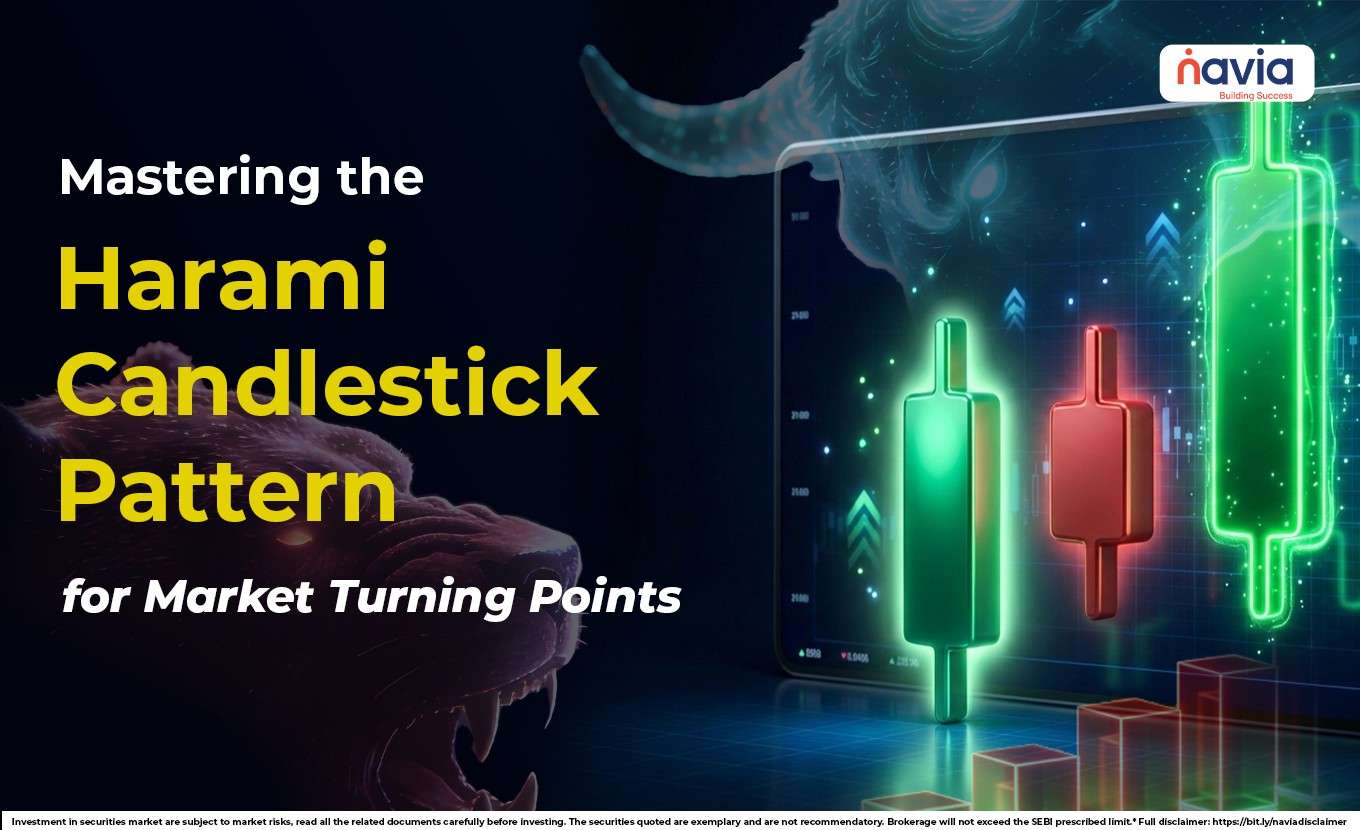
The word “Harami” derived from the old Japanese word, means, “pregnant”. The name is a literal description of the pattern’s appearance, and the harami candlestick pattern has two candles, they are;
🔸 The Mother Candle: A large candle that represents the prevailing trend
🔸 The Baby Candle: A much smaller candle that is completely contained within the body of the previous large candle.
When you see a harami candle, it indicates that the current momentum is exhausting. The market is indecisive, and the aggressive side is losing its grip.
The Bullish Harami: Spotting the Bottom
A bullish harami occurs at the end of a downtrend, that signals the selling pressure is dying up, and buyers are starting to step in. But how to identify a bullish harami candlestick pattern, here are some points that will help you.
| Context | The market must be in a clear downtrend |
| First Candle | A long, red (bearish) candle that shows the bears are in total control |
| Second Candle | A small green (bullish) candle. Crucially, the body of this green candle must be entirely “tucked” inside the body of the previous red candle |
When the Bullish Harami appears at a major support level, it may suggest increased buying interest at that level, preparing a potential trend of reversal to the upside.
The Bearish Harami: Warning of the Top
The bearish harami appears at the peak of an uptrend, that serves as a warning to long-term holders that the rally might be over. Let’s see the characteristics of a bearish harami candlestick pattern.
| Context | The market is in an established uptrend, making higher highs |
| First Candle | A large green (bullish) candle representing extreme optimism |
| Second Candle | A small red (bearish) candle that opens and closes within the range of the previous green candle’s body |
The bearish harami candlestick pattern suggests that despite the previous day’s strength, the bulls couldn’t push the price higher. The “containment” of the second candle shows that the supply is beginning to meet the demand.

How to Trade the Harami Pattern Effectively?
Spotting a harami candle is just a half of the battle, to manage risk effectively, traders often follow a disciplined execution strategy, that includes;
Wait for Confirmation
Never trade solely on the Harami pattern itself; you must wait for the third candle or the confirmation candle.
🔹 For a bullish harami, wait for the third candle to close above the high of the “mother” Candle.
🔹 For a bearish harami, wait for the third candle to close below the low of the “mother” Candle.
Check the Volume
Reversal signals are often considered stronger when supported by higher volume. If the bullish harami candlestick pattern forms on low volume, but the following confirmation candle shows a spike in volume.
Use Support and Resistance
A harami in the middle of nowhere is often just “noise”. However, a bearish harami hitting a multi-year resistance level or a bullish harami bouncing off a 200-day Moving Average may provide additional technical confirmation.
Common Mistakes to Avoid
| Ignoring the Wicks | While the “body” of the second candle must be inside the body of the first, the wicks (shadows) don’t necessarily have to be. However, for a “perfect” Harami, the entire second candle remains within the first. |
| Trading Against the Macro Trend | If the overall market is in a massive bull run, a Bearish Harami might only lead to a minor sideways consolidation rather than a full reversal. |
| Forgetting Stop-Losses | No pattern is 100% accurate. Always place your stop-loss: Bullish Trade: Below the low of the mother candle. Bearish Trade: Above the high of the mother candle. |
| Entering Without Confirmation | Harami shows that the trend might stop, not that it has reversed. You must wait for the “confirmation candle.” For Bullish Harami: Wait for a third candle to close above the high of the first (mother) candle. For Bearish Harami: Wait for a third candle to close below the low of the first (mother) candle. |
| Confusing Harami with the Engulfing Pattern | In an Engulfing Pattern, the second candle is larger and “eats” the first. In a Harami, the second candle is smaller and “tucked inside” the first. So, you must remember the difference between both. |
Conclusion
The harami candlestick pattern is a testament to the idea that “less is more” in trading. By identifying these moments of silence and indecision, you may identify early signs of changing market momentum. Whether it is a standard harami candle, a powerful harami cross or a classic bearish harami candlestick pattern, these formations tell the story of a changing guard between buyers and sellers.
You can monitor these “pregnant” candles in the charts on the coming days; they might just be the quietest way to hear what the market is planning next.
Do You Find This Interesting?
We’d Love to Hear from you-

Frequently Asked Questions
What does a harami candle indicate?
The Harami candlestick pattern is a two-candle Japanese formation that signals a potential trend exhaustion or price reversal. Depending on the preceding price action, it can manifest as either bullish or bearish, serving as a vital alert that the current market momentum is shifting.
What are the best harami strategies?
Traders may consider different approaches based on their risk tolerance, with the Harami pattern you can choose between three distinct approaches:
An aggressive entry involves buying immediately as the pattern forms at a key support level to capture the earliest move; a conservative entry requires waiting for a third bullish candle to confirm a genuine shift in momentum; or a breakout strategy, where you enter only once the price clears the “mother” candle’s high for the highest probability setup.
How to identify a bullish harami?
The Bullish Harami signals a potential trend reversal by nesting a small, upward-moving candle within the body of a preceding large downward candle. This formation indicates that selling pressure is exhausting, which some traders interpret as an early indication of momentum shift.
What is the success rate of bullish harami?
According to research by Thomas N. Bulkowski in his Encyclopedia of Candlestick Charts, the bullish harami demonstrates a reversal success rate of roughly 54%. While this provides a slight statistical edge, it highlights that the pattern is most effective when combined with other technical indicators rather than being used as a standalone signal.
What happens after a harami candle?
The Harami pattern is a two-session formation where a large “mother” candle on Day 1 completely encapsulates a smaller “baby” candle on Day 2. When this specific alignment appears at the base of a downtrend, it is identified as a Bullish Harami, signaling a potential pause in selling and an upcoming reversal to the upside.
DISCLAIMER: Investments in the securities market are subject to market risks, read all the related documents carefully before investing. The securities quoted are exemplary and are not recommendatory. Brokerage will not exceed the SEBI prescribed limit.