

Portfolio Management Services: Discretionary vs Non-Discretionary vs Advisory
In Indian equity markets, managing a high-net-worth portfolio involves multiple considerations beyond stock selection; it requires selecting a suitable management model. Portfolio Management Services or PMS are investment services that generally used by High-Net-worth Individuals (HNIs) and it offers direct asset ownership and specialized strategies.
So, before making investment decisions, it is important to understand the difference between discretionary and non-discretionary pms, as well as where advisory pms fits into the equation.
💡 Quick Answer
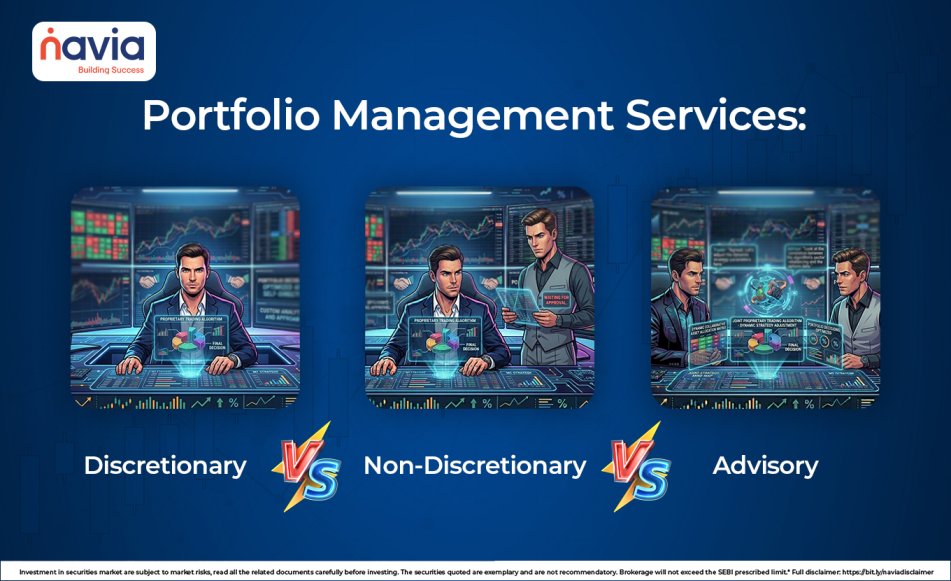
Portfolio Management Services (PMS) come in three models that differ in who decides and who executes. In discretionary PMS, a SEBI-registered manager makes and executes every trade for you. In non-discretionary PMS, the manager advises but you approve each trade. In advisory PMS, the manager only recommends and you execute yourself. Control rises — and fees typically fall — as you move from discretionary to advisory.
Discretionary PMS: The Hands-Off Choice
For busy professionals and those who prefer professional management, discretionary and non-discretionary pms are often compared, with the former being one of the available PMS models. In discretionary model, SEBI-registered portfolio manager has the authority as per agreement to make all buying, selling, and asset allocation decisions on your behalf. Let’s see the benefits of it;
| Speed | Since client approval is not required for every trade, subject to the terms agreed with the client, subject to conditions. |
| Professional Rigor | Investment decisions are based on the manager’s investment process and research methodology as outlined in the PMS agreement. |
| Convenience | May appeal to investors who prefer delegated portfolio management preferring minimal involvement who want to outsource the entire portfolio management process. |
Non-Discretionary PMS: The Collaborative Path
Non-discretionary PMS is a hybrid model where the portfolio manager provides research and suggestions, but the final action (Buy or Sell) only placed after your explicit approval. The debate between discretionary and non-discretionary in the final decision rests with the investor who want the benefit of professional research but wish to maintain a veto power over their assets. While this offers more control, it can sometimes lead to delay may impact execution timing if there are delays in communication.
Advisory PMS: The Independent Approach
Advisory PMS or PMS advisory services represents the offers a higher degree of client control. Here, the manager acts solely as a consultant, and they provide personalized strategies and recommendations, but the investor is also responsible for executing the trades in your own account.
This model is generally used by experienced investors who have the time and tools to execute trades but want a second opinion from professional strategists to support portfolio decision-making.
Detailed Comparison: Discretionary vs Non-Discretionary vs Advisory
| Aspect | Discretionary PMS | Non-Discretionary PMS | Advisory PMS |
|---|---|---|---|
| Decision-Maker | Portfolio Manager | Investor (after advice) | Investor |
| Trade Execution | Manager | Manager (after approval) | Investor |
| Client Control | Low | Moderate | High |
| Time Requirement | Minimal | Moderate | High |
| Typically Used By | Investors preferring delegated management | Active collaborators | Investors preferring independent execution |
PMS Requirements and Regulations
In India, all PMS types are regulated by SEBI under the Portfolio Managers Regulations, 2020. So, understanding these pms requirements is essential for compliance, that include, the minimum investment requirement is ₹50 lakh (as per current regulations), the provider must maintain a minimum net worth of ₹5 crore, and providers are required to provide periodic disclosures including performance and risks.
While many ask that what is pms period, in simple term, it generally refers to the investment horizon or the lock-in period specified in the agreement, often aligned with market cycles. And the pms charges typically includes;
- Fixed Management Fee: Usually, 1% to 2.5% of the Assets Under Management (AUM) annually.
- Performance Fee: A performance-linked fee structure (often 10-20%) that may apply when returns exceed a pre-agreed “hurdle rate.”
- Operating Costs: Includes brokerage, custodian fees, audit fees, and an 18% Goods and Services Tax (GST) on the management fee.
Generally, discretionary services have the may involve higher fees due to the level of active management involved, while advisory services are the may involve relatively lower costs.
Conclusion
The choice between discretionary, non-discretionary, and advisory PMS depends on an investor’s preferences, involvement in investment decisions, financial objectives, and risk tolerance. Investors should carefully review the PMS agreement, fee structure, investment approach, and associated risks before selecting any portfolio management service. If you are still deciding between broad financial planning and pure portfolio management, see our comparison of wealth management vs portfolio management.
Key Takeaways
- PMS comes in three models: discretionary, non-discretionary and advisory.
- Discretionary PMS lets the manager trade without per-trade approval — the least client involvement.
- Non-discretionary PMS is collaborative: the manager advises, but you approve each trade.
- Advisory PMS gives you the most control — the manager only recommends and you execute.
- In India, PMS is regulated by SEBI (Portfolio Managers Regulations, 2020), with a ₹50 lakh minimum investment.
Did you find this article helpful?
Your feedback helps us write better content.

Frequently Asked Questions
What is the difference between non-discretionary PMS and advisory PMS?
Non-Discretionary PMS involves a collaborative approach where the investor maintains enhanced control while receiving professional guidance from the portfolio manager. Advisory PMS provides the maximum level of investor control, with the portfolio manager acting strictly as an advisor.
What is the difference between discretionary and non-discretionary advisory?
In a non-discretionary account, the broker is required to contact you and obtain your permission before executing any trades. Conversely, in a discretionary account, the broker is authorized to use their own judgment to buy or sell securities without consulting you or receiving prior approval.
What are the two types of PMS?
Portfolio Management Services (PMS) are available in two forms: discretionary and non-discretionary. In a discretionary PMS, the manager executes investment decisions without needing client approval for individual transactions. In a non-discretionary PMS, the manager provides advice, but the client must approve every transaction before it is executed.
Which is better, discretionary or non-discretionary?
Non-discretionary PMS is may be considered by investors with market understanding and wish to retain control over their investment decisions. For all other investors, discretionary PMS is may be suitable, as it grants the portfolio manager full authority to manage investments.
What is non-discretionary PMS?
Non-Discretionary Portfolio Management Service (NDPMS) is a more may involve lower costs where the manager serves primarily as a client advisor. In contrast to Discretionary PMS (DPMS), the Portfolio Manager in an NDPMS structure is not authorized to make decisions on the client’s behalf.
DISCLAIMER: Investment in securities market are subject to market risks, read all the related documents carefully before investing. The securities quoted are exemplary and are not recommendatory. Full disclaimer: https://bit.ly/naviadisclaimer.