

Forward Contracts and Futures Contracts: What Makes Them Different?
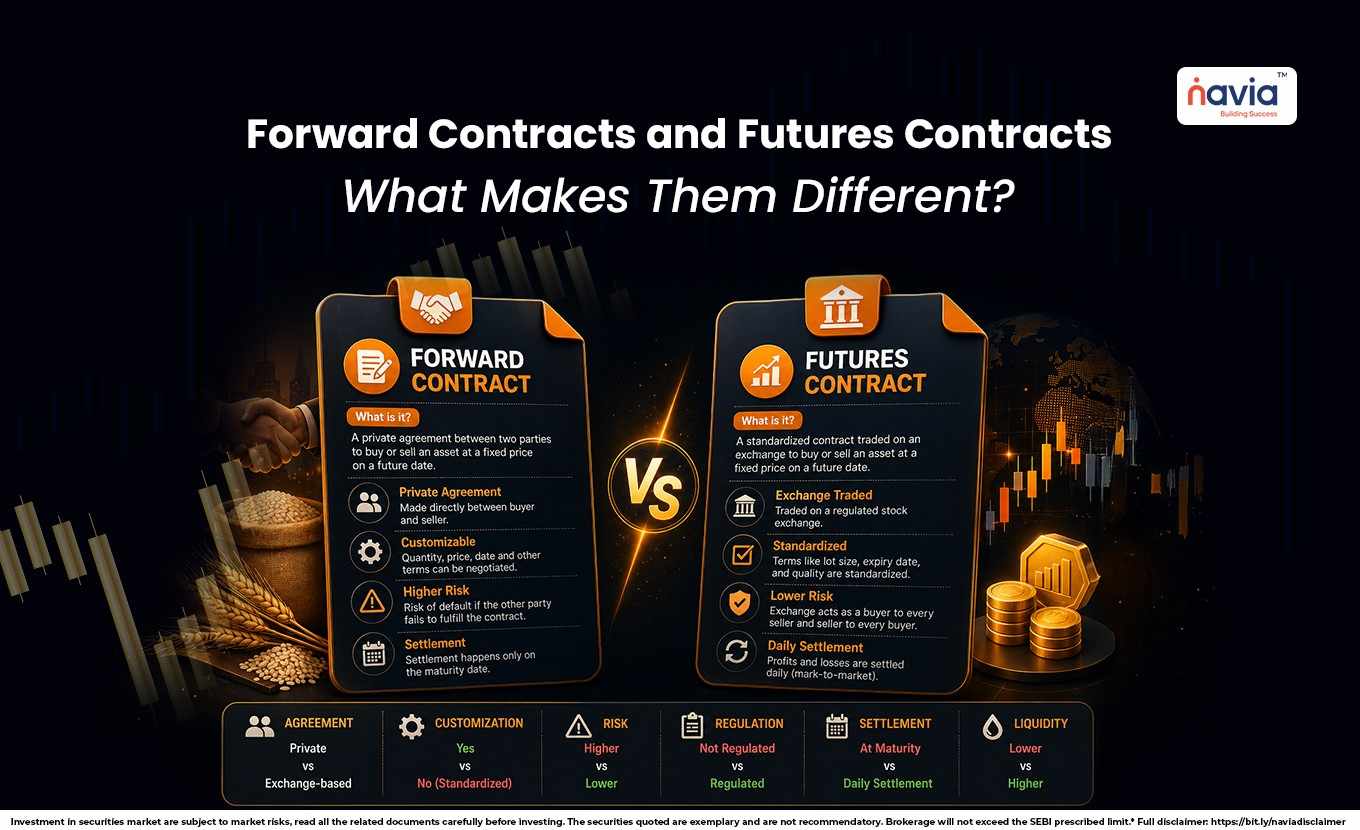
Forward and futures contracts are both derivative instruments used to agree on price for a future date, but they work in different ways. The main difference between forward contracts and futures contracts is that forwards are private and customizable, while futures are standardized and traded on exchanges.
For students and investors searching for the difference between future and forward contracts, a simple way to understand this is: forwards are flexible but less liquid, while futures are more regulated, transparent, and easier to trade.
💡 Quick Answer
Forward and futures contracts both fix a price today for a transaction on a future date, but forwards are private, customizable, over-the-counter agreements, while futures are standardized contracts traded on an exchange. Futures use margin and daily mark-to-market to lower counterparty risk; forwards offer more flexibility but carry higher counterparty risk.
What is a Forward Contract?
A forward contract is a private agreement between two parties to buy or sell an asset at an agreement on a price for a future date. Because it is negotiated directly, terms such as quantity, settlement date, and asset details can be customized.
Forwards are usually traded over the counter, which means they are not exchange-traded. This gives them flexibility, but it may involve higher counterparty risk because there is a possibility of a default by one party.
What is a Futures Contract?
A futures contract is a standardized agreement to buy or sell an asset at a future date at a fixed price. These contracts are traded on exchanges, which generally offer higher transparency and liquidity compared to forwards.
Futures also require margin and are settled daily through mark-to-market, which may reduce counterparty risk through clearing mechanisms. This makes futures commonly used by active traders are institutional participants and institutional participants who want regular price tracking and easier exit options.

What are the Key Differences?
Here is a simple comparison of future vs forward contracts:
| Feature | Forward Contracts | Futures Contracts |
|---|---|---|
| Trading venue | Over the counter, private agreement | Exchange-traded |
| Standardization | Customized terms | Standardized terms |
| Liquidity | Lower liquidity | Higher liquidity |
| Counterparty risk | Generally, higher risk | Generally, lower risk due to clearinghouse |
| Settlement | Usually at maturity | Daily mark-to-market |
| Margin requirement | Typically, no exchange margin | Margin required |
If you are specifically looking for the difference between future contracts and forward contracts, the biggest points are standardization, trading methods, and risk management.
Where Is Each Used?
Forwards are often used by businesses that want to hedge specific future costs or revenues. Because they can be tailored, they are commonly used in situations where a standard market contract may not fit well.
Futures are widely used by traders, speculators, and hedgers who want exchange-traded to manage exposure to price movements. Their daily settlement and standardized design make them widely used by market participants.
Example
Suppose an importer wants to lock in the price of currency three months later. A forward contract can be customized exactly for that need.
Now suppose a trader wants to speculate on the price of crude oil with a contract that can be traded quickly and marked to market every day. A futures contract is usually commonly used in such scenarios.
Conclusion
The difference between forward and futures contracts comes down to flexibility versus structure. Forwards are private, customizable, and less liquid, while futures are exchange-traded, standardized, and offer standardized processes.
So, when comparing future and forward contracts, forwards are typically used for traders who value transparency, liquidity, and lower counterparty risk.
Key Takeaways
- Both forwards and futures lock in a price now for a transaction on a future date.
- Forwards are private, customizable OTC agreements; futures are standardized and exchange-traded.
- Futures use margin and daily mark-to-market, which reduces counterparty risk via a clearinghouse.
- Forwards are more flexible but usually less liquid and carry higher counterparty risk.
- Forwards suit custom hedging needs; futures suit traders who want liquidity and transparency.
Did you find this article helpful?
Your feedback helps us write better content.

Frequently Asked Questions
What is the main difference between future and forward contracts?
The main difference is that forwards are private and customizable, while futures are standardized and exchange traded.
Are forward contracts may involve higher counterparty risk than futures?
Yes. Forward contracts usually have higher counterparty risk because they are private agreements.
Do futures require margins?
Yes. Futures generally require margins and are marked to market daily.
Which is commonly used for hedging depending on requirements?
Both can be used for hedging, but forwards are better for custom needs, and futures are better when standard contracts are acceptable.
Are forward contracts customized?
Yes. Forward contracts can be tailored to suit the needs of the two parties.
DISCLAIMER: Investment in securities market are subject to market risks, read all the related documents carefully before investing. The securities quoted are exemplary and are not recommendatory. Full disclaimer: https://bit.ly/naviadisclaimer.