

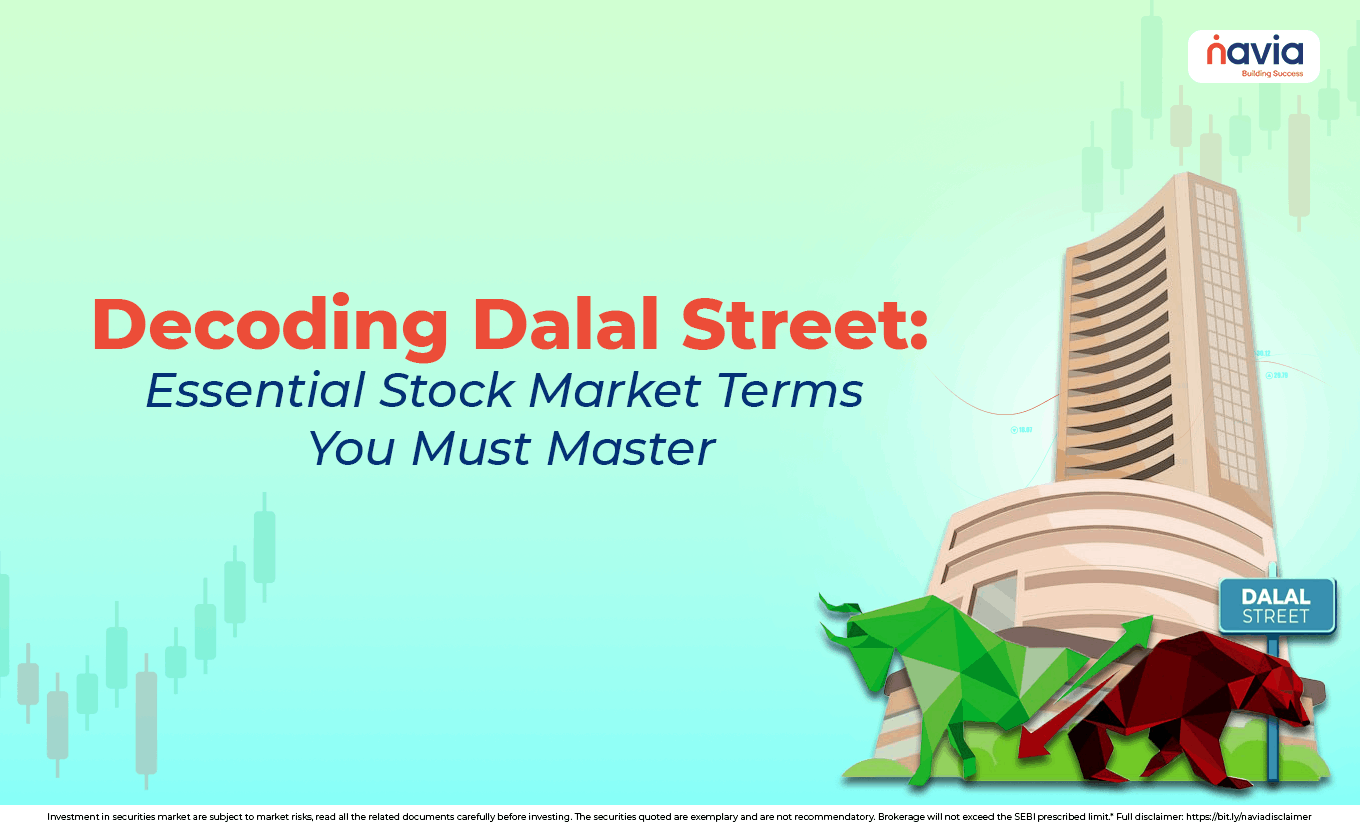
Decoding Dalaal Street: Essential Stock Market Terms You Must Master
The stock market is an open playground; anybody can get into it without any barriers (but you must be at least 18 years old). If you are interested in trading, you don’t need a finance degree; you just need to know what people are talking about when they discuss the share market terms and definitions.
But there are some of the terms you must understand before making decisions. To help you cut through the confusion, we’ve compiled a glossary of stock market foundational terms that every new investor must know.
💡 Quick Answer
Most stock market jargon falls into four buckets. Fundamentals describe what you own — stock, equity, market capitalisation, index, Initial Public Offering (IPO), dividend, bond. Market conditions describe the mood — bull market, bear market, volatility, liquidity, blue-chip. Trading mechanics describe how orders actually work — bid and ask, spread, market order, limit order, portfolio, broker. Analysis terms describe how you judge value — Price-to-Earnings (P/E) ratio, Earnings Per Share (EPS), capital gain or loss, volume. Learn these four groups and most market commentary becomes readable.
Part I: The Fundamentals
Below you can see the terms that are the basic building blocks and structure of the market;
| Terms | Definition |
|---|---|
| Stock/Share | It means a unit of ownership in a company. If you buy a share, you are becoming a part-owner of that company. |
| Equity | The value of ownership interest in a company, typically in the form of common or preferred stocks. It refers to the capital invested by shareholders. |
| Market Cap or Market Capitalization | The total value of a company’s share means the company’s total worth in the open market. According to the value, the stocks are classified into large-cap, mid-cap and small-cap. |
| Index (Nifty & Sensex) | It’s a statistical measure that tracks the performance of a basket of selected stocks. The Sensex tracks major stocks on the BSE and Nifty track top 50 major stocks of NSE. |
| Initial Public Offering (IPO) | If a company sells shares of its stock to the public to raise capital for the first time, that was an IPO. |
| Dividend | A portion of a company’s profit is distributed to the shareholders, that are usually paid quarterly or annually. |
| Bond | A fixed-income instrument that represents a loan made by an investor to a borrower. |
If the mechanics of buying and selling are still unfamiliar, this primer on stock trading explained for beginners walks through the whole process end to end.
Part II: The Market Conditions
These terms describe the overall sentiment and direction of the stock exchange, and these are the crucial part of the share market glossary. In India, the two principal exchanges are the NSE and the BSE.
| Terms | Definition |
|---|---|
| Bull Market | A market condition characterized by rising stock prices and general confidence. |
| Bear Market | A market condition characterized by falling stock prices and market decline. |
| Volatility | A measure of the speed and frequency of price changes in a stock or the market. High volatility: Swing dramatically Low volatility: Stable |
| Liquidity | How easily and quickly a stock can be bought or sold without affecting its price. |
| Blue-Chip Stocks | Stocks of well-established, financially stable, and leading companies with a long history of reliable performance. |

Part III: The Trading Mechanism
If you understand this share market terminology will help to execute trades correctly.
| Terms | Definition |
|---|---|
| Bid and Ask Price | Bid: The highest price a buyer is willing to pay for stock. Ask: The lowest price a seller is willing to accept for a stock. |
| Bid-Ask Spread | It is the difference between the highest bid price and the lowest ask price. |
| Market Order | It’s like an instruction to immediately buy or sell a stock at the best available current market price. |
| Limit Order | This instruction is to buy or sell a stock only at a specific price that you set. |
| Portfolio | A collection of all the investments owned by an individual. |
| Broker / Brokerage Account | A firm or person that executes your buy and sell orders. They will hold your money and securities used for trading. |
Each of these deserves a closer look. There are far more than two order types available — see the full list of stock market order types. The gap between bid and ask is a real, recurring cost, explained in detail in what is the bid-ask spread. And the price you see quoted on a screen is usually the last traded price, not a live offer — that distinction is covered in what LTP means in the stock market.
Part IV: The Analysis & Performance
If you want to evaluate a company’s financial health, you can utilize these terms.
| Terms | Definition |
|---|---|
| Price-to-Earnings Ratio (P/E Ratio) | This valuation metric is calculated by dividing the stock’s current price by its Earnings Per Share (EPS). |
| Earnings Per Share (EPS) | A company’s net profit is divided by the total number of outstanding shares. |
| Capital Gain / Loss | The profit (gain) or deficit (loss) is realized when you sell an investment for a higher or lower price than you bought it for. |
| Volume | The total number of shares of a stock that has been traded during a specific period. |
The Bottom Line
This stock market glossary is like your foundational dictionary. For any successful output, it is necessary for a better foundation, right? But you don’t need to memorize every formula; you must understand the meaning of these terms. After understanding these fundamental definitions, it not only helps you to make good investment decisions, but also focuses on financial news, and follow analyst reports too.
The language of the market is no longer a secret, now that you know, so the next movement is to understand the conversation.
Key Takeaways
- A share is a unit of ownership; equity is the shareholders’ stake; market capitalisation is what the market thinks the whole company is worth.
- Bull and bear describe direction; volatility describes how violently prices move; liquidity describes how easily you can get in and out.
- A market order prioritises speed of execution; a limit order prioritises the price you are willing to accept, at the risk of not filling.
- The bid-ask spread is the built-in cost of every round trip — the wider the spread, the more the trade costs you before the price even moves.
- You need both a trading account (to place orders on the exchange) and a demat account (to hold the securities electronically).
- Related reading: stock trading explained, types of stock market orders, what is LTP, and what is the bid-ask spread.
Did you find this article helpful?
Your feedback helps us write better content.

Frequently Asked Questions
What is the difference between Stock and Bond?
Stock refers to a unit of ownership in a company. You become a part-owner, sharing in the company’s profits (via dividends) and growth (via price appreciation). Bond represents a loan you make to a company or government. You are a creditor who receives fixed interest payments, and the principal is returned at maturity.
Why do traders talk about the P/E Ratio?
The Price-to-Earnings (P/E) Ratio is the most widely used metric for stock valuation. Traders use it to determine if a stock is cheap or expensive relative to its earnings.
A high P/E suggests investors expect high future growth or that the stock may be overvalued. And a low P/E suggests the stock might be undervalued or that the company has low growth expectations.
What is the simplest way to explain a Bull Market versus a Bear Market?
Bull Market: The Optimist is in charge. Prices are generally rising, investor confidence is high, and the expectation is that things will keep improving.
Bear Market: The Pessimist is in charge. Prices are generally falling, confidence is low, and the expectation is that the decline will continue.
Why do I need a Demat and Trading Account to invest in the stock market?
You need both accounts to legally and digitally transact:
Trading Account: This is the account used to place the orders (Buy or Sell) on the stock exchange (like NSE or BSE).
Demat Account (Dematerialized): This is the account used to hold the securities (stocks, bonds, etc.) in electronic form after a purchase is successfully executed.
Should I use a Market Order or a Limit Order?
It depends on your priority:
Market Order: Use this when speed is your priority (i.e., you need to buy or sell immediately). You prioritize execution over price.
Limit Order: Use this when the price is your priority. You set the exact price you are willing to pay or receive, but there’s a risk your order may not be filled if the price never reaches your specified limit.
DISCLAIMER: Investment in securities market are subject to market risks, read all the related documents carefully before investing. The securities quoted are exemplary and are not recommendatory. Full disclaimer: https://bit.ly/naviadisclaimer.