

Physical Settlement of Stock F&O: What Happens If You Hold to Expiry
Quick answer
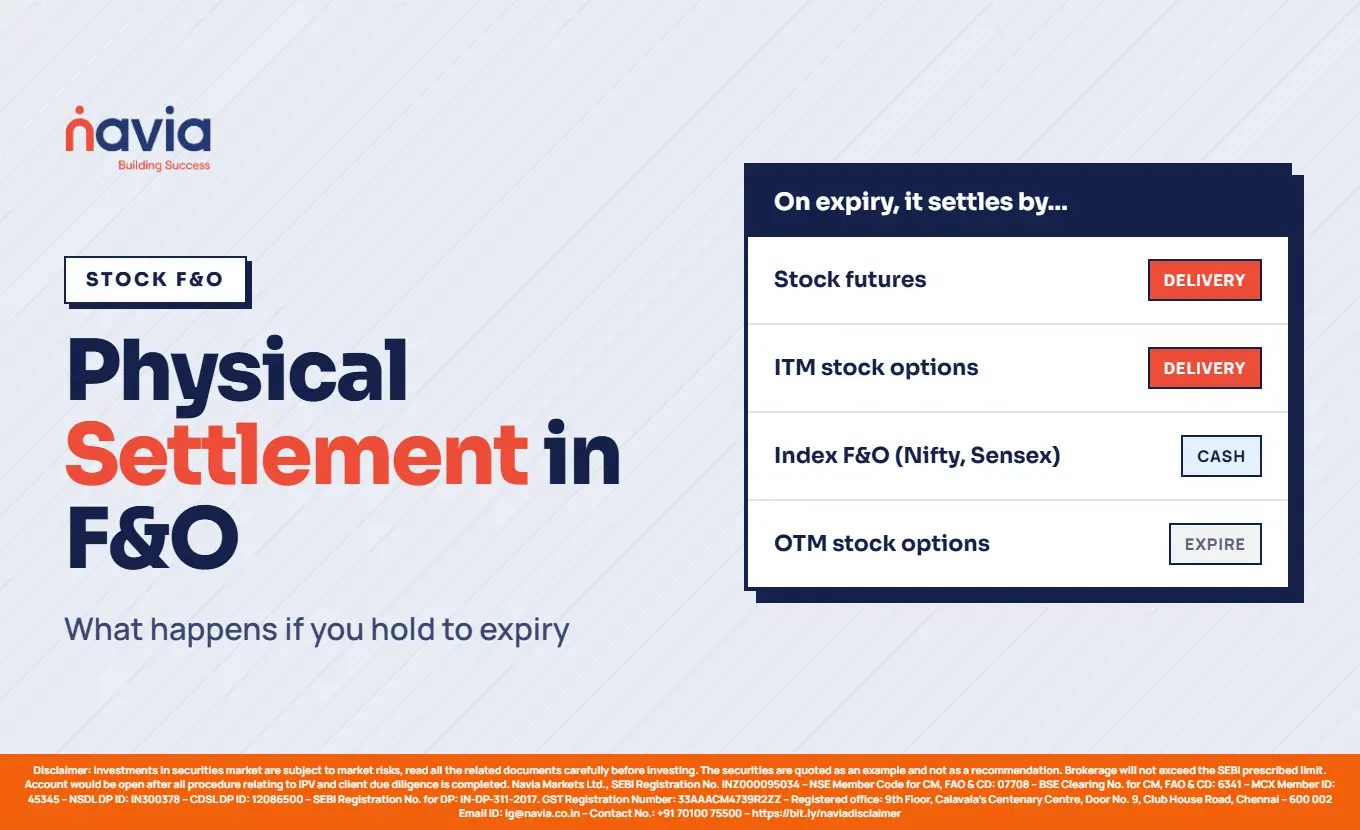
Stock futures and in-the-money stock options are settled by physical delivery of shares, not in cash. If you hold one to expiry, the obligation is calculated on the full contract value, not on the margin you posted, which is why it is usually several times larger than the capital committed. Index derivatives, including Nifty and Sensex, remain cash settled and are unaffected. Zero brokerage does not extend to delivery: at Navia, delivered shares attract brokerage of 0.50% of the delivered value.
Key takeaways
- Stock futures and in-the-money stock options are physically settled; all index derivatives remain cash settled.
- Compulsory physical settlement applies to stock derivatives following SEBI’s circular of 11 April 2018, fully effective from the October 2019 expiry.
- NSE stock monthly contracts expire on the last Tuesday, BSE stock monthly contracts on the last Thursday, following the 2025 expiry-day restructuring.
- Delivery margins begin four trading days before expiry and reach 25% of notional contract value on E−1 and 50% of contract value on expiry day at Navia.
- On a ₹1,00,000 contract with an 18% combined margin rate, the requirement rises from ₹1,800 at E−4 to ₹50,000 on expiry day.
- Taking delivery requires 100% of the notional contract value, intent raised before 11:00 am on expiry day, and 0.50% brokerage on the delivered value.
What is physical settlement in F&O?
Physical settlement means a derivatives contract is settled by actual delivery of the underlying shares into or out of a demat account, rather than by a cash payment of the difference.
Most people learning what F&O trading involves assume every contract settles in cash, because that is how index contracts work. For stock derivatives it is not the case. SEBI moved stock derivatives to compulsory physical settlement in a phased programme set out in its circular of 11 April 2018. Delivery began with the July 2018 expiry for the first tranche of securities and was extended in stages, with the remaining stocks moving from the October 2019 expiry. Since then, a stock F&O position carried to expiry produces a delivery obligation, not a cash adjustment.
Which contracts are physically settled?
The distinction is by underlying, not by instrument.

Physically settled: stock futures, and stock options that finish in the money. Both long and short positions carry an obligation — a long call or short put takes delivery, a short call or long put gives delivery.
Cash settled: all index derivatives, including Nifty and Sensex futures and options. Index contracts settle against the final settlement price with no delivery.
No obligation: stock options that finish out of the money expire worthless, with nothing to deliver.

When is the F&O expiry date for stock contracts?
The date that matters is not expiry day. It is four trading days earlier, because that is when delivery margins begin to apply, whether or not you intend to take delivery.
Stock derivatives have monthly contracts only; there are no weekly contracts on individual stocks. On NSE, stock monthly contracts expire on the last Tuesday of the expiry month. On BSE, stock monthly contracts expire on the last Thursday. This follows the 2025 restructuring, in which SEBI limited each exchange to a single expiry day and the exchanges chose Tuesday and Thursday respectively. NSE’s contract specification for individual securities is the current reference. Where the expiry date falls on a market holiday, expiry moves to the previous trading day.
What happens if you hold a stock F&O position to expiry?
The obligation is calculated on the full contract value, not on the margin you posted.
A trader holding one lot of a stock option that finishes in the money is obliged to settle the entire contract value. If the position was taken with a small premium outlay, the gap between what was paid and what is now owed can be very large. This is the part that surprises people: the position was sized against the premium, but the obligation is sized against the stock.
How do delivery margins increase before expiry?
Delivery margins are additional to the SPAN and exposure margins already blocked against the position, and they rise each day. The schedule below is Navia’s own requirement, applicable to in-the-money options. The exchange-prescribed minimum, set by NSE Clearing circular 009/2020, is 10%, 25%, 45% and 70% of the applicable capital-market margin on each of the four days to expiry; a broker may require more.
| Day | Margin requirement |
|---|---|
| Expiry day − 4 | 10% of (VaR + ELM + ad-hoc margins) |
| Expiry day − 3 | 25% of (VaR + ELM + ad-hoc margins) |
| Expiry day − 2 | 45% of (VaR + ELM + ad-hoc margins) |
| Expiry day − 1 | 25% of notional contract value |
| Expiry day | 50% of contract value |
Note what happens between E−2 and E−1. The basis changes, from a percentage of the risk margins to a percentage of the contract value itself. That is where the requirement jumps.
Worked example. A position in stock ABC with a notional contract value of ₹1,00,000, where VaR is 10%, ELM is 5% and an ad-hoc margin of 3% applies. The combined margin rate is 18%, or ₹18,000.
| Day | Calculation | Margin required |
|---|---|---|
| Expiry day − 4 | 10% of ₹18,000 | ₹1,800 |
| Expiry day − 3 | 25% of ₹18,000 | ₹4,500 |
| Expiry day − 2 | 45% of ₹18,000 | ₹8,100 |
| Expiry day − 1 | 25% of ₹1,00,000 | ₹25,000 |
| Expiry day | 50% of ₹1,00,000 | ₹50,000 |

The requirement moves from ₹1,800 to ₹50,000 across four trading days on a single ₹1,00,000 contract. A trader who funded the account for the premium and nothing more will be short well before expiry day, and a shortfall attracts a penalty calculated on the gap.
Delivery margin schedule and example per Navia’s physical delivery margin policy, retrieved 13 October 2026.
What does physical delivery cost?
Four costs apply, and the largest of them is the one traders miss.
The practical point is that a position which cost very little to open can cost a great deal to settle. Anyone comparing brokers on the lowest brokerage charges for F&O should look at the physical delivery rate as well as the per-order rate, because they are charged separately. Every charge is listed on the Navia pricing page.

How do you take physical delivery at Navia?
Four requirements, and the deadline is the one to note.

Maintain 100% of the notional contract value in the account. Hold an active demat account with Navia. Communicate your intent to take physical delivery by raising a support ticket before 11:00 am on expiry day. Delivery brokerage of 0.50% then applies on the value of the shares delivered.
If intent is not communicated and the margin obligation is not met, the position is subject to square-off rather than delivery.
How do you avoid physical settlement?
Three options, in descending order of how much they cost you.
Taking no action is not a strategy. An option sitting near the strike can finish in the money on a small move, and the delivery margin applies to the position from four days out regardless of where it eventually settles.
A note on risk
Conclusion
Stock futures and in-the-money stock options settle by delivery of shares, not in cash, and have done since the October 2019 expiry. The obligation is calculated on the full contract value. Delivery margins begin four trading days before expiry and rise sharply at the one-day mark, when the basis changes from the risk margins to the contract value itself. Taking delivery at Navia requires the full notional contract value in the account, intent communicated before 11:00 am on expiry day, and brokerage of 0.50% on the delivered value. The reliable way to avoid all of it is to close or roll the position before the margin cycle starts.
Educational content, not investment advice. Figures are illustrative; check the current margin schedule and charges before you trade.
Did you find this article helpful?
Your feedback helps us write better content.

Frequently Asked Questions
Is physical settlement compulsory in F&O?
For stock derivatives, yes. Stock futures and in-the-money stock options are compulsorily settled by delivery. Index derivatives, including Nifty and Sensex, remain cash settled.
What happens if I do not have funds for physical delivery?
A margin shortfall attracts a penalty under exchange norms, and Navia may square off the position. Where a position cannot be squared off, it may proceed to compulsory physical delivery, with all costs borne by the client.
Do out-of-the-money options get physically settled?
No. Options that finish out of the money expire worthless and create no delivery obligation. Options close to the strike can finish in the money on a small move, so delivery margins apply beforehand regardless.
What is the F&O expiry date for stock contracts?
Stock derivatives are monthly only. NSE stock contracts expire on the last Tuesday of the month, BSE stock contracts on the last Thursday, moving to the previous trading day if that date is a holiday.
Does zero brokerage on F&O apply to physical delivery?
No. Delivery is settled separately from ordinary F&O orders and attracts brokerage of 0.50% of the value of the shares delivered at Navia.
When do delivery margins start being charged?
Four trading days before expiry, rising each day until expiry, in addition to the SPAN and exposure margins already applied to the position.