

Switching Brokers Mid-Year: What Happens to Your Holdings, SIPs and MTF
Quick answer
Three things in your account behave differently when you change brokers. Shareholdings transfer, through a closure-cum-transfer or an off-market transfer. SIPs do not transfer; they must be stopped with the old broker and registered again with the new one, because the registration is tied to the distributor code used when it was set up. A margin trading facility position cannot be transferred at all, because the shares are pledged in your existing broker’s favour as security for funding. It must be sold, or the funded amount repaid in full to release the pledge, before the account can close.
Key takeaways
- Unencumbered shares transfer between demat accounts without being sold, retaining their original cost and purchase date.
- An MTF position cannot be transferred, because the shares are pledged in the existing broker’s favour under SEBI’s margin pledge framework.
- MTF must be exited by selling or by repaying the funded amount in full; interest accrues daily until it is settled.
- Funds from an MTF sale become available in the following trading session, because unpledging completes alongside settlement.
- A SIP does not transfer. Stop it before switching, or the next instalment is still processed under the old broker’s code.
- Mutual fund units in demat form move by demat transfer; units in statement form move by a change of distributor code, which does not affect NAV, holding period or tax.
In this article
- What moves and what does not?
- What happens to your shareholdings?
- Why can an MTF position not be transferred?
- What does it cost to exit MTF before switching?
- What happens to your SIPs?
- What happens to mutual fund units you already hold?
- What happens to pledged shares held as collateral?
- Must the new account be in your own name?
- How long does it take, and what does it cost?
- In what order should you switch?
- Conclusion
- Frequently asked questions
What moves and what does not?
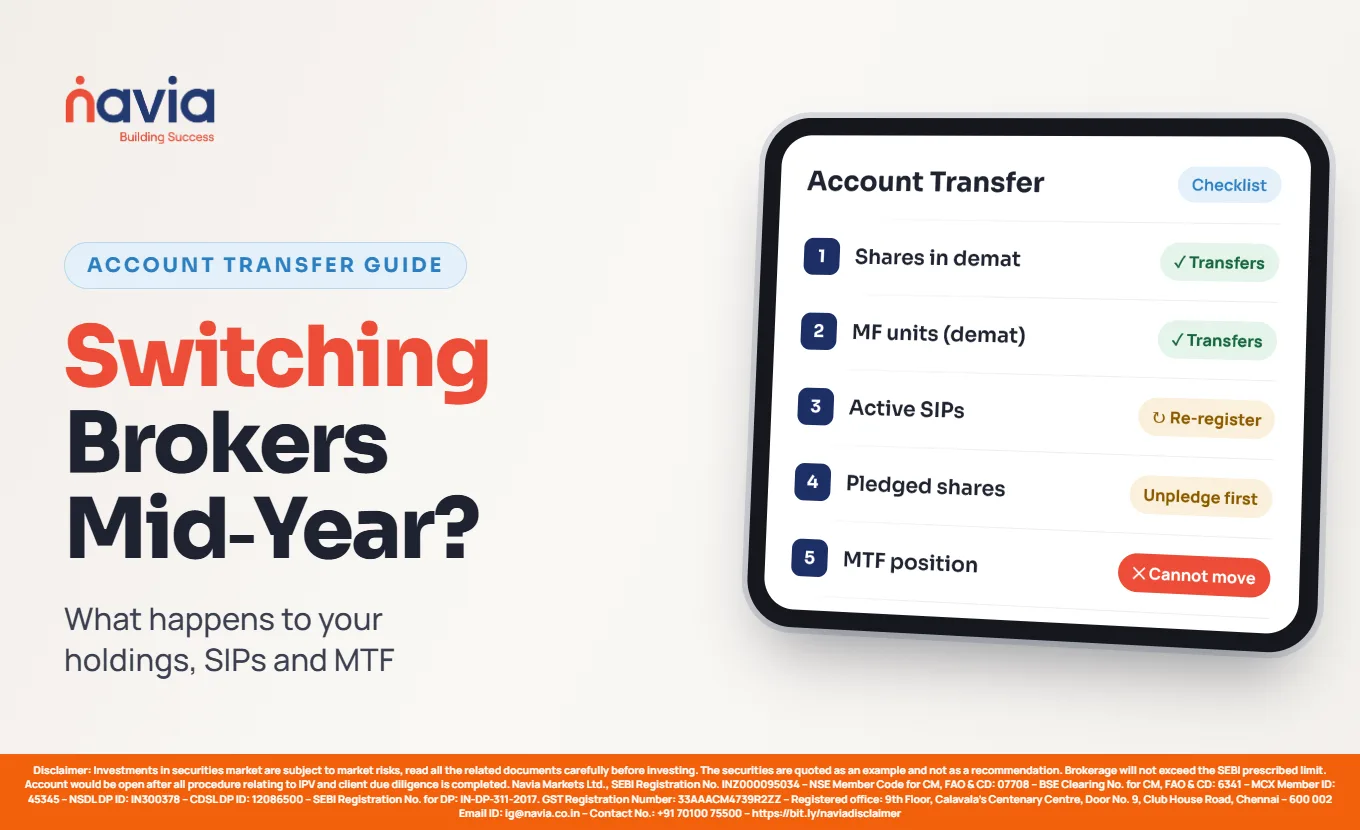
| What you hold | Does it transfer? | What is required |
|---|---|---|
| Shares in demat, unencumbered | Yes | Closure-cum-transfer, or an off-market transfer |
| Mutual fund units held in demat | Yes | Demat transfer through your depository participant |
| Mutual fund units held in statement form | Not a transfer | Change of distributor code with the registrar, where the fund permits it |
| An active SIP | No | Stop with the old broker, register again with the new one |
| An MTF position | No | Sell, or repay the funded amount in full to release the pledge |
| Shares pledged as collateral | Not while pledged | Unpledge first, then transfer |

Unencumbered shares held in demat form transfer without being sold. When you transfer shares from one broker to another, the purchase price and purchase date carry across, so a transfer between accounts in your own name is not a sale and does not trigger a capital gain at that point.
The route depends on whether you are closing the old account. If you intend to transfer the demat account itself and shut it, a closure-cum-transfer moves the eligible holdings and closes the account in a single request. If you intend to keep both accounts open, an off-market transfer moves selected holdings and leaves the original account active. Demat account transfer charges are set by the broker sending the shares, not the one receiving them, so check your existing broker’s tariff before you begin.
- Use closure-cum-transfer to move holdings and close the old account
- Use an off-market transfer to keep both accounts open
- Keep the new account’s DP ID and Client ID ready
- Transfer charges are set by the sending broker
- Pledged shares will not move until released
- Unpaid dues can block a closure request
Why can an MTF position not be transferred?
This is the part that most often stalls a switch, and the reason is structural rather than procedural.
Under the margin trading facility, the broker funds part of your delivery purchase. The shares bought are not held as ordinary holdings. They are pledged with the depository in the broker’s favour. SEBI’s circular on margin obligations being given by way of pledge and re-pledge (SEBI/HO/MIRSD/DOP/CIR/P/2020/28, 25 February 2020, since amended) requires it: funded stocks under the margin trading facility are to be held by the broker only by way of pledge, in a separate account tagged “Client Securities under Margin Funding Account”. The pledge is what secures the funding.
A pledged balance is not carried across by a transfer. In a closure-cum-transfer the depository moves your free balances and leaves the rest behind: CDSL’s account-closure guidance states that ISINs under pledge, under lock-in, or frozen for debit or credit will not be transferred. The position is also a liability, not only an asset: the funded amount is money owed to your existing broker, and a new broker has no mechanism to assume it.

There are therefore two ways out, and only two. Sell the position, which closes the funding and releases the pledge. Or pay the funded amount in full, which converts the holding to ordinary delivery, releases the pledge, and leaves shares that can then be transferred like any others. Our guide to margin trade funding covers how the facility works in more detail.
- Sell the position to close the funding and release the pledge
- Or repay the funded amount in full to convert it to delivery
- Settle sooner to reduce the interest
- Interest accrues daily until the position is settled
- Pledge closure: 0.02% of value, min ₹50, plus GST
- Sale proceeds arrive in the following trading session
What does it cost to exit margin trading facility before switching?
Four costs apply, and three of them are time-sensitive.
The alternative, repaying in full, avoids the selling charges and keeps the position intact, but requires the cash.
Navia charges as published at navia.co.in/pricing and in its depository charges schedule, retrieved 13 October 2026. Charges at your existing broker will differ.

What happens to your SIPs?
A SIP does not transfer, and the reason is that it is not held in your demat account at all.
A systematic investment plan is a standing registration between you, the asset management company and your bank mandate, recorded against the distributor code used when it was set up. Changing brokers does not change that registration. The instalments continue under the original arrangement until you stop them.
If you switch brokers without stopping the SIP first, the next instalment is still processed under the old broker’s code. People discover this when a debit appears after they believed the relationship had ended.

The correct sequence is to stop the SIP with the existing broker, confirm the instruction has taken effect before the next instalment date, and then register a fresh SIP with the new broker. The new registration is a new SIP rather than a continuation, so the instalment date and amount both need to be set again.
One exception worth knowing: if you invest in direct plans, no distributor code is involved, and a change of broker does not affect the SIP.
- Stop the SIP with your existing broker
- Confirm it has stopped before the next instalment date
- Register a fresh SIP and set the date and amount again
- Instalments continue under the old distributor code
- A debit after you believe you have left
- The new SIP is a fresh registration, not a continuation
What happens to mutual fund units you already hold?
Units you have already bought are unaffected in ownership terms. How they move depends on the form in which they are held.
Units held in demat form move like any other security, through a transfer instruction to your depository participant. Units held in statement form are maintained by the fund’s registrar rather than the depository, and are not transferred at all. What changes there is the distributor code attached to the folio, where the fund permits a change, and that change does not affect the net asset value, the holding period, the tax position or ownership.
Units held in demat form cannot be moved by a change of distributor code, and units held in statement form cannot be moved by a demat transfer. Confirm which form yours are in before raising either request.
- Demat form: transfer through your depository participant
- Statement form: change the distributor code with the registrar
- Check which form your units are in first
- A demat transfer cannot move statement-form units
- A code change cannot move demat units
- A code change is possible only where the fund permits it
What happens to pledged shares held as collateral?
Shares pledged to provide margin for derivatives positions behave like MTF holdings: they cannot be transferred while the pledge stands.
Release them by closing the positions they support, then unpledging. The same depository pledge closure charge applies. Work backwards from this, because an open derivatives position that depends on pledged collateral cannot be left in place while the underlying shares move accounts.
- Close the derivatives positions the shares support
- Unpledge the shares
- Then include them in the transfer
- The depository pledge closure charge applies
- Open positions cannot stay while the shares move
Must the new account be in your own name?
It must be your own account. Inside the depository system the test is a match of PAN between the source and the target account, and for a joint holding the same holders in the same sequence.
If the target account is not your own, the request does not fail. It leaves the transfer-cum-closure route and has to be executed as an ordinary off-market transfer on a delivery instruction slip, authenticated with an OTP — a point NSDL set out in its July 2025 policy guidelines on closure of demat accounts (NSDL/POLICY/2025/0090).
The difference shows up in what you pay. SEBI’s Master Circular for Depositories (SEBI/HO/MRD/MRD-PoD-1/P/CIR/2024/168, 3 December 2024) bars a depository from charging a participant, and a participant from charging you, when you transfer all the securities in your account to another branch, another participant or another depository — but only where the accounts at both ends are identical in all respects, and for a joint account in the same sequence of ownership. A transfer that falls outside those conditions is an ordinary off-market transfer and carries the participant’s usual charges.
Whether you need a Client Master Report from the new broker now depends on the route. For a transfer-cum-closure within NSDL, where the depository validates the PAN at both ends, NSDL has exempted the requirement with effect from 14 July 2025 (NSDL/POLICY/2025/0089). For a transfer between the two depositories it is still required, and CDSL continues to ask for one signed or stamped by an official of the new participant.
- Open the new account under the same PAN
- For a joint account, keep the holders in the same sequence
- Move everything in one request — the fee waiver covers a transfer of all holdings
- A different PAN pushes the request onto an off-market slip with OTP
- That route forfeits the no-charge treatment
- Only free balances move: pledged and frozen ISINs stay behind
How long does it take, and what does it cost?
Two working days, once the request is complete and nothing is owed. NSDL’s July 2025 guidelines require a participant to process a closure or transfer-cum-closure request in its systems within two working days of receiving a duly completed and signed form, where there are no outstanding dues. CDSL adopted the same timeline from the same date.
Where dues are outstanding you are given up to 30 calendar days to clear them. Clear them and the two-working-day clock applies; leave them and the request is rejected, with intimation. This is the practical reason the sequence in the next section matters — an unsettled MTF balance is an outstanding due.
On cost, three rules in the same SEBI master circular work in your favour. No charge may be levied for closing the account. No charge may be levied on the transfer itself, on the conditions in the section above. And annual maintenance charges collected in advance must be refunded to you pro rata for the unused quarters.
Stamp duty is a separate question, and it turns on consideration rather than on who owns the account. Duty is collected on an off-market transfer only where a consideration amount is recorded for it, and SEBI has confirmed in its FAQs on the Indian Stamp Act that off-market transfers without consideration do not attract it. Where consideration is recorded, a delivery-based transfer of securities other than debentures is charged at 0.015 per cent.
One balance behaves differently from the rest. Securities under lock-in travel with your free holdings when both accounts are with the same depository. Moving them to the other depository is not part of the ordinary transfer: NSDL routes locked-in balances through the corporate action mechanism instead, and CDSL transfers only free balances when the destination is a participant of the other depository. The lock-in itself is an attribute of the holding and survives the move; it does not reset and it does not lapse.
- Clear every due before you file, so the two-day clock can start
- Check whether both accounts sit with the same depository
- Expect the pro-rata refund of any AMC paid in advance
- Outstanding dues put the request on a 30-day hold
- Locked-in holdings do not cross between depositories the ordinary way
- Stamp duty follows the consideration recorded, not the account
In what order should you switch?

Sequence matters more than speed, because several of these steps block each other.
-
1
Stop any active SIPs and confirm the instruction has taken effect before the next instalment date.
-
2
Close or convert MTF positions, allowing for interest accruing until they are settled.
-
3
Close derivatives positions that depend on pledged collateral, then unpledge the shares.
-
4
Settle any outstanding dues with the existing broker, since unpaid dues are the most common cause of a rejected closure request.
-
5
Open the new account and obtain its DP ID and Client ID.
-
6
Raise the closure-cum-transfer or off-market transfer for the remaining holdings.
-
7
Register fresh SIPs with the new broker.
Conclusion
Switching brokers is three separate exercises, not one. If you are still choosing where to move, run through the 10 checks for a zero-brokerage demat account first. Unencumbered shareholdings transfer intact, with their original cost and holding period. SIPs do not transfer and must be stopped and re-registered, before the switch rather than after. An MTF position cannot transfer under any circumstances, because the shares securing it are pledged to the existing broker, and it has to be sold or repaid first. Sequence the exits before raising the transfer request and the switch is straightforward.
Educational content, not investment or tax advice. Check your existing broker’s tariff and your own tax position before you switch.
Did you find this article helpful?
Your feedback helps us write better content.

Frequently Asked Questions
Can I transfer an MTF position to another broker?
No. The shares are pledged as security for funding provided by your existing broker, and a pledged balance cannot be transferred while the pledge stands. The position must be sold or the funded amount repaid in full.
Will my SIP continue if I change brokers?
Yes, which is usually not what people expect. The registration sits with the asset management company against the original distributor code, so instalments continue until you stop them. Stop the SIP before switching.
Do I pay capital gains tax when transferring shares to a new broker?
A transfer between demat accounts in your own name does not change ownership, so it is not a sale. Tax depends on your circumstances; confirm your position with a qualified tax adviser.
What are MTF charges when closing a position?
Interest on the funded amount until settlement, a depository charge on pledge closure, and the usual charges on the sale if you sell rather than repay. Rates vary by broker; check your broker’s tariff.
Can I switch brokers with an open derivatives position?
Positions themselves do not transfer. Where pledged shares provide the collateral, those shares cannot move until the positions are closed and the pledge released.
What happens to mutual funds I bought through my old broker?
The units remain yours. Those held in demat form transfer with your other holdings; those held in statement form stay with the registrar, and only the distributor code attached to the folio changes.
How long does it take to transfer a demat account?
Two working days, where the request is complete and nothing is owed. NSDL’s July 2025 policy guidelines require a participant to process a closure or transfer-cum-closure request within two working days of receiving a duly completed and signed form, and CDSL adopted the same timeline from the same date. Where dues are outstanding, you are given up to 30 calendar days to clear them before the request is rejected.
Is there a charge to transfer my demat account to another broker?
Closing the account carries no charge, and the transfer itself carries none either, provided you move all the securities in the account and both accounts are identical in all respects — for a joint account, in the same sequence of ownership. A partial transfer, or one to an account held differently, falls outside that and attracts the participant’s ordinary off-market charges. Any annual maintenance charge collected in advance must be refunded pro rata.
Do I need a Client Master Report from the new broker?
It depends on the route. For a transfer-cum-closure within NSDL, where the depository validates the PAN at both ends, NSDL exempted the requirement with effect from 14 July 2025. For a transfer between the two depositories it is still required, and CDSL continues to ask for one signed or stamped by an official of the new participant.
Can locked-in shares be transferred to a new broker?
Within the same depository, securities under lock-in move along with your free holdings. Moving them to the other depository is handled differently: NSDL routes locked-in balances through the corporate action mechanism, and CDSL transfers only free balances when the destination is a participant of the other depository. The lock-in travels with the holding and neither resets nor lapses.
Can I raise the transfer myself online?
Both depositories offer a route for submitting the instruction yourself — easiest at CDSL and SPEED-e at NSDL. Sending securities to an account that has not been pre-notified, which includes your own new account at another broker, needs the higher grade of access secured by a digital signature or e-token rather than the password-only grade.
DISCLAIMER: Investment in securities market are subject to market risks, read all the related documents carefully before investing. The securities quoted are exemplary and are not recommendatory. Brokerage will not exceed the SEBI prescribed limit. Full disclaimer: https://bit.ly/naviadisclaimer
MUTUAL FUND DISCLAIMER: Investment in Mutual Fund market are subject to market risk. There is no guaranteed or assured rate of return. Past performance is not an indication of future returns. Please read all related documents carefully before investing.
DERIVATIVES: Trading in F&O involves substantial risk.
Navia Markets Ltd. · SEBI Registration No. INZ000095034 · NSE Member Code for CM, F&O & CD: 07708 · BSE Clearing No. for CM, F&O & CD: 6341 · MCX Member ID: 45345 · NSDL DP ID: IN300378 · CDSL DP ID: 12086500