

Top 5 Algo Trading Strategies for Beginners
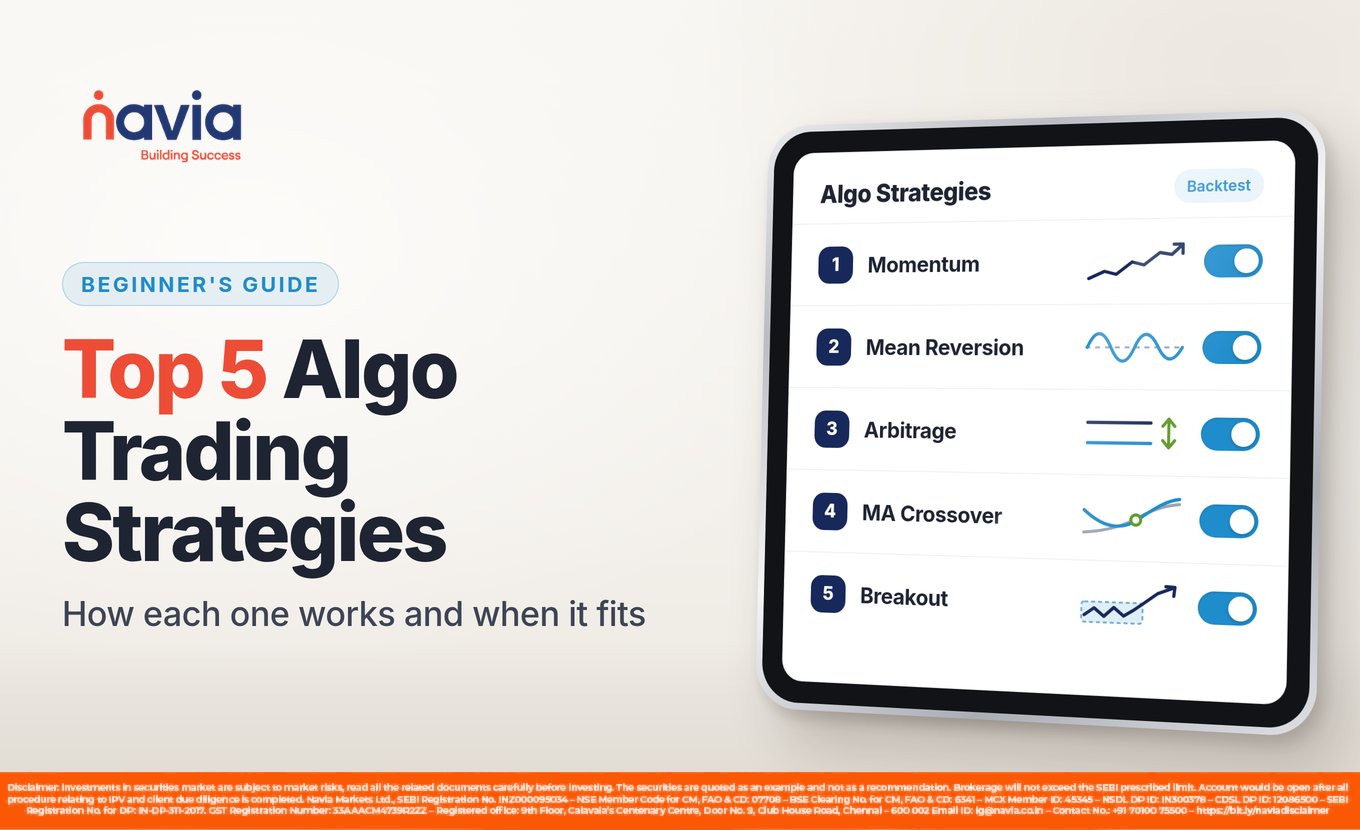
Algorithmic trading used to be the preserve of institutional desks with deep pockets and dedicated quant teams. That’s changed. With retail platforms now offering rule-based order execution, beginners can build and run their own strategies without writing a single line of code. But “algo trading” isn’t one thing — it’s an umbrella over several distinct approaches, each with its own logic, risk profile, and market conditions where it performs best. Here are five of the most widely used strategies to know before you place your first automated order.
Momentum Trading
Trend-following
Momentum strategies are built on a simple premise: stocks that have been rising tend to keep rising for a while, and stocks that have been falling tend to keep falling. The algorithm scans for assets showing strong directional price movement — often confirmed with indicators like the Relative Strength Index (RSI), Moving Average Convergence Divergence (MACD), or a simple price rate-of-change — and enters trades in the direction of that trend.
The logic isn’t about predicting reversals; it’s about riding an established move until signs of exhaustion appear.
- Markets are trending strongly
- Volume confirms the price move
- News or earnings create sustained direction
- Choppy, range-bound markets
- Late entries chasing an exhausted move
- Sudden trend reversals
Mean Reversion
Contrarian
Mean reversion takes the opposite view: prices that stray too far from their historical average tend to snap back toward it. The strategy identifies a “fair value” — often a moving average or a statistical band like Bollinger Bands — and trades against short-term extremes, buying when price dips well below the mean and selling when it spikes well above.
This approach thrives in sideways, range-bound markets where price oscillates rather than trends, and it’s a favourite for pairs trading and statistical arbitrage setups.
- Price is range-bound, not trending
- Volatility is stable and predictable
- Asset has a strong historical average
- Strong trending markets (the “mean” keeps moving)
- Structural breaks — fundamentals that change permanently
- Catching a falling knife
Arbitrage
Market-neutral
Arbitrage strategies exploit tiny, temporary price discrepancies for the same or related asset across different markets or instruments — for example, a stock trading at a slightly different price on two exchanges, or a mismatch between a stock’s cash price and its futures price. The algorithm simultaneously buys the cheaper version and sells the costlier one, locking in a small, low-risk profit.
Because these gaps close in seconds, arbitrage depends heavily on execution speed and low transaction costs — it’s one of the strategies where automation isn’t just helpful, it’s essential.
- Fast, reliable order execution is available
- Brokerage and slippage costs are low
- Liquid instruments with tight spreads
- Opportunities vanish quickly — latency matters
- Thin margins can be wiped out by costs
- Heavy competition from institutional players
Trend Following with Moving Average Crossovers
Rule-based / Systematic
A close cousin of momentum trading, this strategy is one of the simplest and most beginner-friendly entry points into algo trading. It uses two moving averages — a shorter-period one and a longer-period one. When the short-term average crosses above the long-term average (a “golden cross”), the algorithm generates a buy signal; when it crosses below (a “death cross”), it signals a sell.
Its appeal lies in transparency: the rules are easy to understand, easy to backtest, and easy to tweak — which makes it a common first strategy for people building their own automated systems.
- Clear, sustained trends are in play
- You want a simple, explainable rule set
- Backtesting on longer timeframes
- Whipsaws in sideways markets
- Lag — crossovers confirm trends late
- Over-optimizing average lengths to past data
Breakout Trading
Volatility-based
Breakout strategies watch for price moving decisively beyond a defined support or resistance level, or outside a consolidation range, and treat that move as the start of a new trend. The algorithm places orders the moment price closes beyond the threshold, often paired with a volume filter to avoid false breakouts.
This works particularly well around known catalysts — earnings announcements, index rebalancing, or macro data releases — where a period of tight consolidation is often followed by a sharp directional move.
- Price has been consolidating in a tight range
- A known catalyst or event is approaching
- Volume confirms the breakout
- False breakouts that quickly reverse
- Slippage during high-volatility moments
- Needs tight stop-loss discipline
Quick Comparison
| Strategy | Best Market Type | Complexity | Speed Dependency |
|---|---|---|---|
| Momentum | Trending | Low–Medium | Medium |
| Mean Reversion | Range-bound | Medium | Medium |
| Arbitrage | Any (price gaps) | High | Very High |
| MA Crossover | Trending | Low | Low |
| Breakout | Consolidation → Trend | Medium | High |
Getting Started
You don’t need to master all five strategies at once. Most beginners start with one — often a moving average crossover or basic momentum system — backtest it thoroughly on historical data, and only then move to live execution with small position sizes. As you get comfortable reading how a strategy behaves across different market conditions, you can layer in more sophisticated approaches like mean reversion or breakout systems.
The common thread across all successful algo strategies isn’t complexity — it’s consistency. An algorithm removes emotion from execution, but it can only be as good as the logic and risk controls built into it.
Automating These Strategies with Navia Algo Trading
Reading about a strategy and actually running it are two different things — and this is usually where beginners get stuck, either because coding feels like a barrier or because manual execution introduces the very emotion an algorithm is supposed to remove. Navia’s algo trading platform is built to close that gap, at zero brokerage on every algo trade.
Here’s how each strategy above maps onto the platform:
- Describe a momentum or MA-crossover rule in plain English and the AI Strategy Builder turns it into a working algorithm
- Or subscribe to a ready-made strategy from the marketplace, filtered by trend direction and logic type
- Backtest any of these five approaches against 10+ years of stock data and 6+ years of full option-chain data
- Forward-test in virtual mode through a live market cycle before switching it on
- Build breakout or mean-reversion logic around Greeks (Delta, Gamma, Theta, Vega) with the Option Basket tool
- Automate trailing stop-loss and target so exits aren’t left to manual reaction time
- A 2-click kill switch pauses or exits any single strategy — or everything — instantly
- Already have TradingView setups? The TradingView Bridge auto-executes your alerts directly on Navia
The practical path is the same one outlined earlier in this article: choose a strategy, backtest it, forward-test it risk-free, and only then go live — Navia’s builder and backtesting engine are designed to walk through exactly those four steps, whether you’re automating a simple moving average crossover or a multi-leg options system.
Educational content — not investment advice. Always evaluate strategies against your own risk appetite before trading.