

Zero Brokerage vs Low Brokerage: Which Account Wins?
💡 Quick Answer
A zero brokerage account charges ₹0 commission on trades. A low brokerage account charges a small flat fee, usually ₹10 to ₹20 per order. Many zero brokerage accounts are zero only on equity delivery, and statutory charges apply either way, so compare the total cost of a trade rather than the commission alone.
“Zero brokerage” and “low brokerage” are used almost interchangeably in trading app marketing, but they are not the same thing, and the difference can change what you actually pay over a year. This guide explains both models in plain terms, compares them side by side, shows why the brokerage line is only part of the cost, and helps you decide which suits how you trade.
What is a zero brokerage trading account?
A zero brokerage trading account is one where the broker charges ₹0 commission for buying or selling, on the trades it covers. Since brokers still need revenue, a zero brokerage broker usually earns from other sources, such as interest on idle funds, margin funding, other charges, or a paid subscription plan. Two things are worth checking. First, many brokers apply zero brokerage only to equity delivery, and charge a flat fee on intraday and F&O. Second, some offer zero brokerage only if you pay a monthly or one time plan fee. True zero brokerage, with ₹0 across every segment and no subscription, is less common.
What is a low brokerage trading account?
A low brokerage trading account charges a small, fixed fee for each order, regardless of the trade size. The typical rate is a flat ₹10 to ₹20 per executed order, or a low percentage such as 0.01% to 0.03%, whichever is lower. This is the discount broker model. The appeal is predictability: you know exactly what each order costs, and a flat fee on a large trade works out far cheaper than the percentage a traditional broker would charge.
Zero brokerage vs low brokerage: the key differences
Here is how the two models compare on the points that matter.
| Factor | Zero brokerage | Low brokerage |
|---|---|---|
| Brokerage per trade | ₹0 | A small flat fee, usually ₹10 to ₹20, or a low % |
| Cost as you trade more | Stays at ₹0 | Adds up, one fee per order |
| How the broker earns | Other charges, float, margin funding or a plan fee | The per order fee itself |
| Common catch | Often zero on delivery only; may need a subscription | The fee, small per trade, is still charged every time |
| Best suited to | Active and large traders; long term investors | Traders who want a fixed, predictable cost |
| Statutory charges | Still apply | Still apply |
Zero brokerage is not zero cost
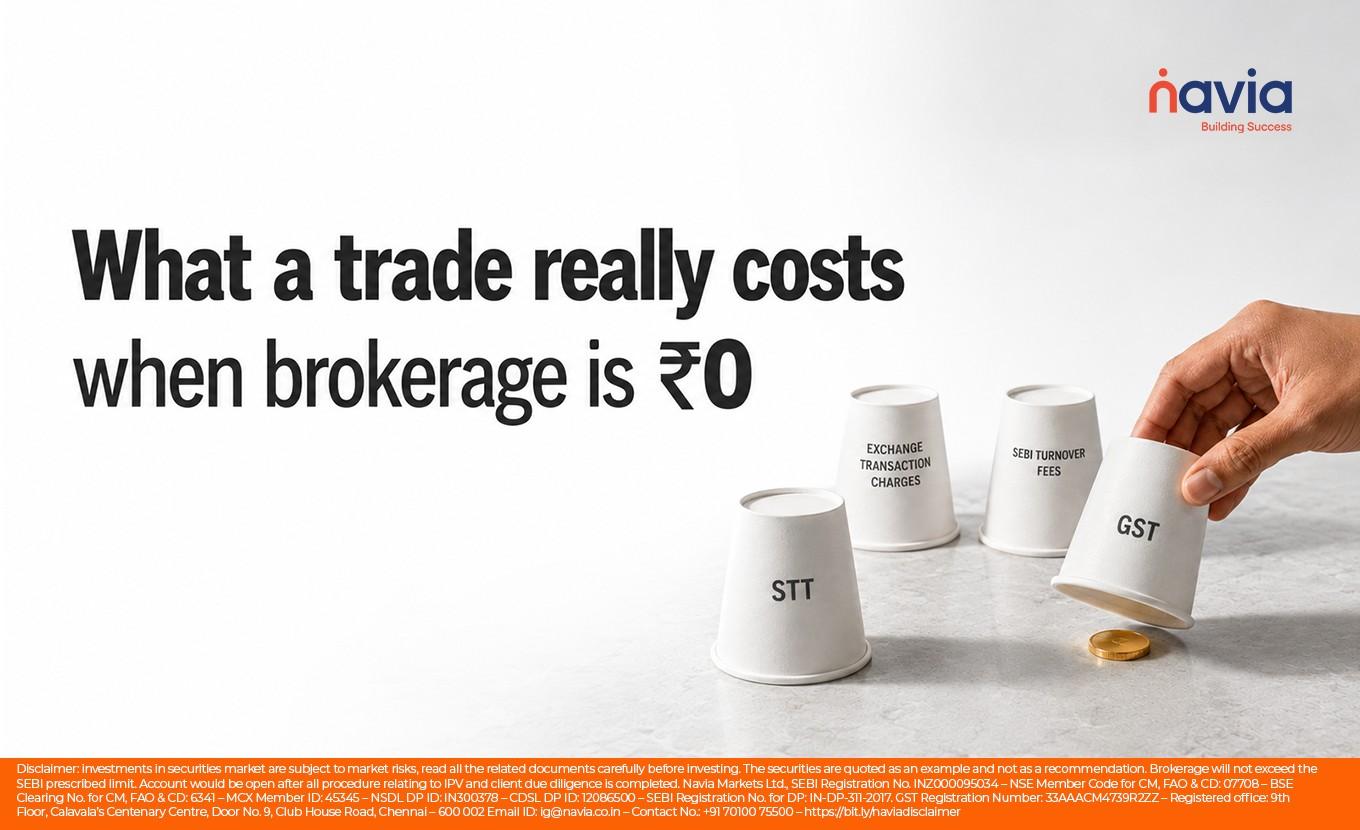
Whichever model you choose, brokerage is only one line on the contract note. Every trade also carries statutory charges set by the government, SEBI and the exchanges, that is Securities Transaction Tax (STT), exchange transaction charges levied by the NSE, BSE or MCX, GST at 18%, a SEBI turnover fee and stamp duty. On many trades these statutory charges are larger than the brokerage itself. On top of that, some accounts carry an annual maintenance charge, DP charges or platform fees. So the only fair comparison is the total cost of a trade. Navia’s pricing page lists every charge that applies, so you can see the full picture before you trade.
Which one is right for you?
It depends on how you trade. If you mainly buy and hold equity for the long term, zero brokerage on delivery is the feature that saves you the most, so look for a broker that offers it without an AMC. If you trade intraday or F&O often, compare the flat fee model against a true zero brokerage broker across those segments, because the fees add up quickly at volume. If you trade occasionally, either model is fine, so focus on transparency, a free demat account and no hidden charges. In every case, before you open an account, check the 10 things that separate a good zero brokerage account from a weak one.
What true zero brokerage looks like
Navia is a true zero brokerage broker. It charges ₹0 brokerage for life across equity delivery, intraday, futures and options, commodities, ETFs and IPOs, with 0% commission on direct mutual funds, and it does this without any monthly or one time subscription. Account opening is free, there is no annual maintenance charge for life, and there are no platform or hidden fees. You pay only the statutory charges that every broker collects, plus a small DP charge when you sell shares from demat.

A note on cost and risk
Lower costs help your net returns, but they do not change the risk of the market. Prices can fall as well as rise, so read the scheme and risk documents before you invest, and choose a broker on cost, safety and service together, not on a single number.
Conclusion
Zero brokerage removes the commission entirely, while low brokerage keeps it small but present. For most active traders and long term investors, a true zero brokerage account is the cheaper choice, as long as it is zero across the segments you use and carries no AMC or hidden fees. Always compare the total cost of a trade, not the brokerage alone. You can open a free account with true zero brokerage on the Navia All in One App. Navia Markets is registered with SEBI (Reg. No. INZ000095034).
Key Takeaways
- A zero brokerage account charges ₹0 commission on the trades it covers, while a low brokerage account charges a small flat fee, usually ₹10 to ₹20 per executed order, or a low percentage such as 0.01% to 0.03%.
- Many brokers apply zero brokerage only to equity delivery and charge a flat fee on intraday and F&O, and some offer it only if you pay a monthly or one time plan fee.
- Statutory charges such as STT, exchange transaction charges, GST at 18%, the SEBI turnover fee and stamp duty apply under both models, and on many trades they are larger than the brokerage itself.
- The only fair comparison is the total cost of a trade, so also check for an annual maintenance charge, DP charges and platform fees.
- Navia charges ₹0 brokerage for life across equity delivery, intraday, futures and options, commodities, ETFs and IPOs, with 0% commission on direct mutual funds, and with no subscription and no AMC.
Did you find this article helpful?
Your feedback helps us write better content.

Frequently Asked Questions
Is zero brokerage really free?
Zero brokerage means no brokerage fee, but not zero cost. Statutory charges such as STT, exchange transaction charges, GST, the SEBI turnover fee and stamp duty still apply to every trade, and a DP charge applies when you sell from demat. Always compare the total cost, not just the brokerage.
Zero brokerage vs low brokerage: which is cheaper?
For frequent or large traders, zero brokerage is usually cheaper because the fee stays at ₹0, while a flat ₹10 to ₹20 per order adds up. For occasional traders the difference is small. In all cases the statutory charges are the same, so compare the full contract note.
Is ₹20 per order zero brokerage?
No. A flat ₹20 per order is low brokerage, not zero. Many brokers charge ₹0 only on equity delivery and a flat fee like ₹20 on intraday and F&O. True zero brokerage means ₹0 across every segment.
Do zero brokerage accounts charge AMC?
Some do. Zero brokerage refers to the trading commission, not the demat account maintenance fee. Many brokers still charge an annual maintenance charge, or AMC, so check for it. Navia charges no AMC, for life.
What is the catch with zero brokerage?
The common catches are that zero brokerage may apply only to equity delivery, that it may require a paid subscription, or that the account carries an AMC or other fees. A true zero brokerage account is zero across all segments with no subscription and no AMC.
Does Navia charge zero brokerage on all segments?
Yes. Navia charges ₹0 brokerage for life on equity delivery, intraday, F&O, commodities, ETFs and IPOs, with 0% commission on direct mutual funds, and with no subscription and no AMC. Statutory charges set by regulators still apply.
DISCLAIMER: Investment in securities market are subject to market risks, read all the related documents carefully before investing. The securities quoted are exemplary and are not recommendatory. Full disclaimer: https://bit.ly/naviadisclaimer