

Zero Brokerage Demat Account: 10 Things to Check First
- 1. Is it from a SEBI registered broker and depository?
- 2. What does zero brokerage actually cover?
- 3. Is account opening free, and is there an AMC?
- 4. What are the DP charges when you sell?
- 5. Which segments and exchanges does it cover?
- 6. How good is the platform and app?
- 7. How easily can you add and withdraw funds?
- 8. Is your account secure, and can you add a nominee?
- 9. What is the support and grievance process?
- 10. How easy is it to open, and can you try first?
- The 10 checks at a glance
- Conclusion
- Frequently Asked Questions
Zero brokerage is a strong hook, but a demat account is a long term home for your money, so the fees and service around it matter as much. Some accounts are free to open but charge an annual fee, or waive brokerage on one segment while charging on another.
💡 Quick Answer
A zero-brokerage account lets you trade without a brokerage fee, but that does not mean zero cost, and not every account is free on every segment. Before you open one, check the broker’s regulation, the segments that are truly free, the opening fee and AMC, DP charges, funding, safety and support. Navia offers a free demat account with no AMC and ₹0 brokerage on eligible trades. Here are the 10 things to check.
1. Is it from a SEBI registered broker and depository?
Start with safety. The account should come from a broker registered with SEBI and a depository participant of NSDL or CDSL, which hold your shares. Navia is registered with SEBI and uses both NSDL and CDSL.
2. What does zero brokerage actually cover?
Some apps waive brokerage on one segment and charge on others, so check which segments are truly ₹0. Navia is ₹0 on equity delivery, intraday, F&O, mutual funds and IPOs, while statutory charges apply.
3. Is account opening free, and is there an AMC?
Many zero brokerage accounts still charge an opening fee or annual maintenance charge (AMC). Navia’s demat opening is free with no AMC, for life.
4. What are the DP charges when you sell?
A DP charge applies when shares leave your demat account on a delivery sell, and it is easy to overlook. At Navia it is 0.03% of the transaction value, with a minimum of ₹30 and a maximum of ₹300 per transaction, listed on the pricing page with the other charges.
5. Which segments and exchanges does it cover?
One account should cover NSE, BSE and MCX and let you trade equity, F&O, mutual funds, IPOs and ETFs. Navia gives all of these from one account.
6. How good is the platform and app?
Look for a stable app and web platform, easy to use and reliable on busy market days. Navia offers mobile and web with dual login, so you can switch between phone and desktop without logging out.
7. How easily can you add and withdraw funds?
Check how quickly you can move money in and out, and which payment methods are supported. Navia’s Insta Funds lets you withdraw to your bank in seconds, any time of day.
8. Is your account secure, and can you add a nominee?
Your account should support a nominee and strong login security such as two factor authentication. Navia supports nominee registration and secure login.
9. What is the support and grievance process?
Check that help is easy to reach and that complaints can go to SEBI’s SCORES portal if needed. Navia offers support and comes under SEBI’s grievance framework.
10. How easy is it to open, and can you try first?
Opening should be online and paperless with digital KYC, and ideally you can try the platform first. Navia uses paperless digital KYC, and a guest mode lets you try the app first.
The 10 checks at a glance
| Check | What good looks like | How Navia handles it |
|---|---|---|
| Regulation and safety | SEBI registered broker; NSDL or CDSL depository | Registered with SEBI; NSDL and CDSL depository participant |
| What zero brokerage covers | ₹0 across the segments you use, not just one | ₹0 brokerage on delivery, intraday, F&O, mutual funds and IPOs |
| Opening fee and AMC | Free opening; low or no AMC | Free account opening; no AMC, for life |
| DP charges | A small, disclosed fee on delivery sells | 0.03% of transaction value, minimum ₹30, maximum ₹300, on a delivery sell |
| Segments and exchanges | NSE, BSE, MCX; equity, F&O, mutual funds, IPOs | All of these from one account |
| Platform and app | Stable, easy mobile and web | Mobile and web with dual login |
| Funds | Fast deposits and withdrawals | Insta Funds withdrawals in seconds |
| Safety and nominee | Nominee and secure login | Nominee registration and secure login |
| Support and grievance | Reachable support; SEBI SCORES | Support plus SEBI grievance framework |
| Easy opening and trial | Paperless digital KYC; try first | Digital KYC; guest mode to try |
Charges and features are from Navia’s published information and may change. For the full list, see how demat account charges work.
Conclusion
A zero brokerage demat account saves you real money, but only if the account is also free to hold, safe and easy to use. Score any account on these 10 checks rather than the loudest claim, and remember that investing carries risk, so read the scheme documents first. You can open a free demat account with no AMC and ₹0 brokerage on the Navia All in One App. Navia Markets is registered with SEBI (Reg. No. INZ000095034).
Key Takeaways
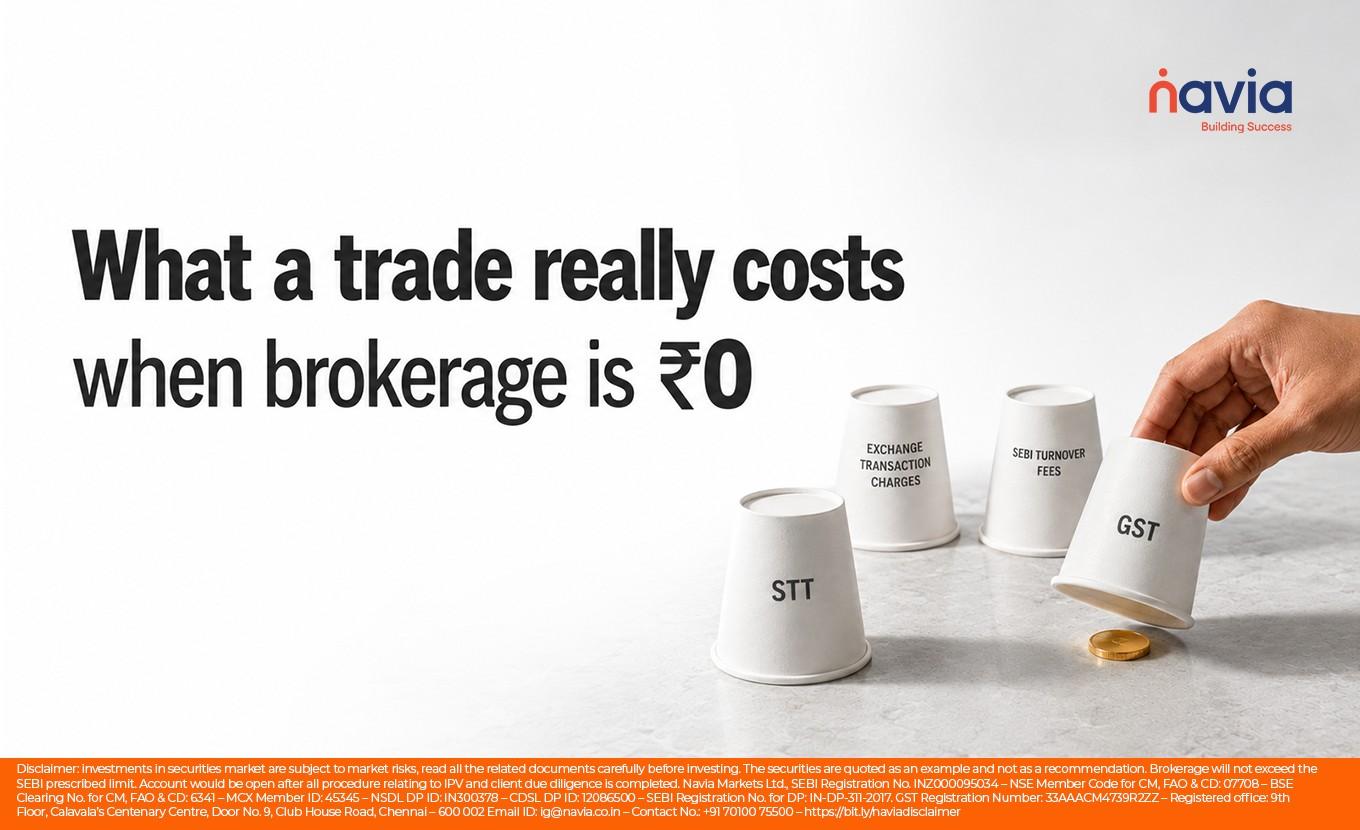
- Zero brokerage removes the brokerage fee, but statutory charges such as STT, GST and stamp duty still apply, and they are the same at every broker.
- Check which segments are truly ₹0 — Navia is ₹0 on equity delivery, intraday, F&O, mutual funds and IPOs.
- Navia’s demat opening is free with no AMC, for life.
- A DP charge of 0.03% of the transaction value, with a minimum of ₹30 and a maximum of ₹300 per transaction, applies when shares leave your demat account on a delivery sell.
- Navia is registered with SEBI, uses both NSDL and CDSL, and comes under SEBI’s grievance framework.
Did you find this article helpful?
Your feedback helps us write better content.

Frequently Asked Questions
Is a zero brokerage demat account really free?
Opening and holding can be free, and Navia charges no opening fee and no AMC. But trades still carry statutory charges such as STT, GST and stamp duty, and a small DP charge applies when you sell from demat.
Does zero brokerage mean no charges at all?
No. Zero brokerage removes the brokerage fee, but statutory charges set by the government and regulators still apply, and they are the same at every broker.
Can I hold mutual funds and IPOs in the same demat account?
Yes. A single demat account can hold equity, mutual funds, IPO allotments, bonds and ETFs, and Navia supports all of these from one account.
How long does it take to open a demat account with Navia?
Navia’s account opening is an online, paperless digital KYC process, completed quickly once your documents are verified.
DISCLAIMER: Investment in securities market are subject to market risks, read all the related documents carefully before investing. The securities quoted are exemplary and are not recommendatory. Full disclaimer: https://bit.ly/naviadisclaimer