

Brokerage Calculator: How much Are you really paying for the trade?
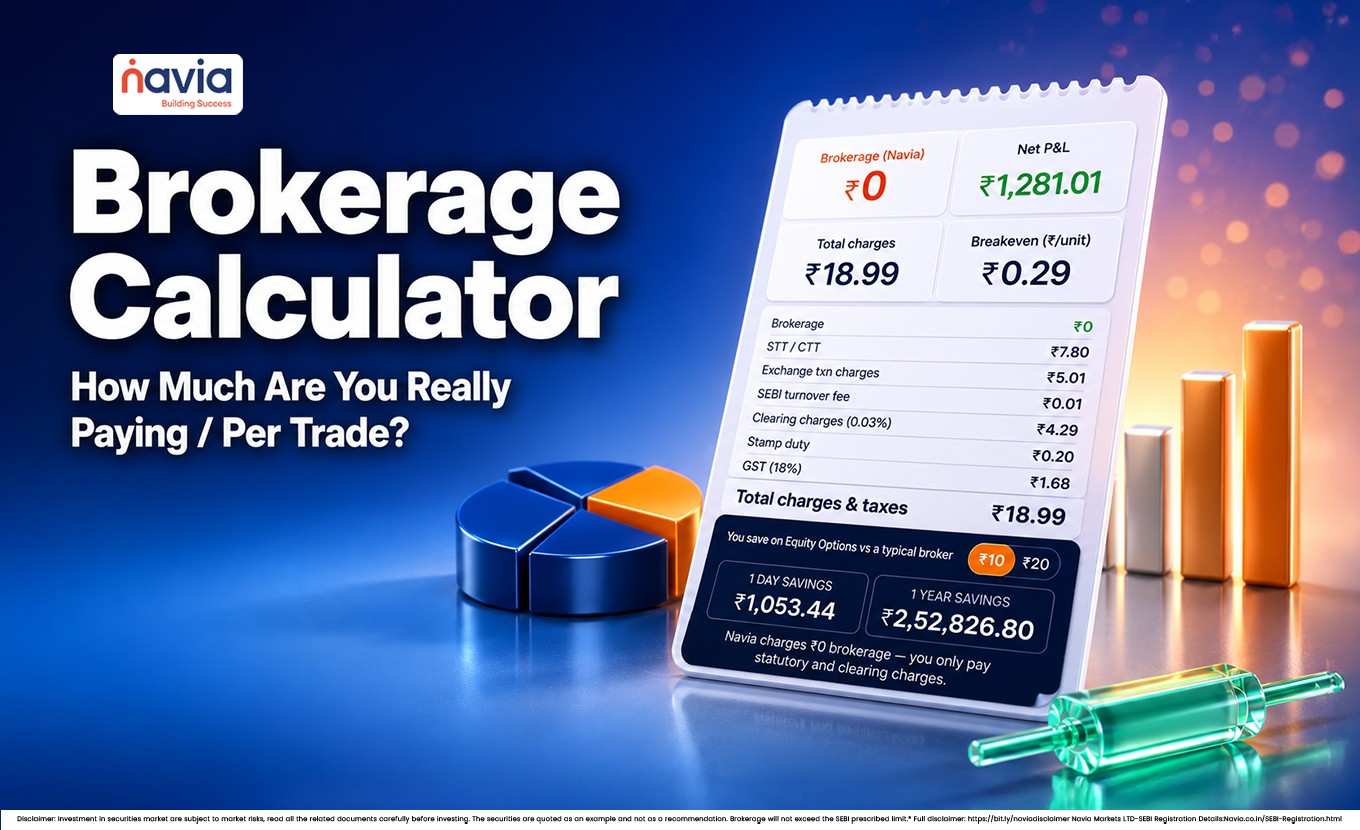
You buy a stock. It goes up. You sell it for a neat profit. But when the money actually lands in your account, it’s a little less than the number you calculated in your head. You didn’t make a mistake — you just forgot to count everyone else who takes a small cut before your profit reaches you: the exchange, the government, the depository, and yes, sometimes the broker too.
A brokerage calculator is the tool that adds all of this up for you before you place a trade, so the number on your screen matches the number in your bank account. In this blog, we’ll break down every charge that goes into a trade in plain language, show you a real worked example, and explain why “zero brokerage” and “zero cost” are two very different things.
A trade’s total cost may include brokerage (where applicable), STT, exchange transaction charges, SEBI turnover fees, GST, stamp duty, and, for delivery trades, DP charges. A brokerage calculator estimates these charges together, helping investors understand the estimated breakeven point before placing a trade.
💡 Quick Answer
A brokerage calculator adds up every charge on a trade — brokerage, STT, exchange transaction charges, the SEBI turnover fee, GST, stamp duty, and (for delivery sells) DP charges — and shows your real net profit or loss, not just the gap between your buy and sell price. “Zero brokerage” only removes the broker’s fee; the statutory charges set by the government, SEBI, and the exchanges apply to every trade, on every broker.
- What Exactly Is a Brokerage Calculator?
- Is ₹0 Brokerage Really Free?
- The Charges Hiding Inside Every Trade
- Delivery vs. Intraday vs. Futures and Options: How the Math Changes
- How to Use a Brokerage Calculator the Right Way?
- Common Mistakes
- Conclusion
- Frequently Asked Questions
What Exactly Is a Brokerage Calculator?
A brokerage calculator is a simple online tool where you enter your buy price, sell price, quantity, and the segment you’re trading in (equity delivery, intraday, futures, or options). It then instantly works out every charge that applies — brokerage, taxes, and regulatory fees — and shows you your net profit or loss, not just the gross difference between your buy and sell price.
Think of it as the difference between the sticker price of something you buy online and the final amount on the checkout page after delivery fees and taxes are added. The stock price movement is the sticker price. The brokerage calculator shows you the checkout page.
Is ₹0 Brokerage Really Free?
Not entirely — and this is the single most misunderstood idea in Indian retail trading today.
“Zero brokerage” means the broker isn’t charging you a fee for executing your order. That part genuinely is free with brokers like the Navia All in One App, which charges ₹0 brokerage across equity delivery, intraday, F&O, commodities, mutual funds, and IPOs.
But brokerage is only one of at least six other charges that apply to every trade — and none of them are optional, because they aren’t set by the broker at all. They’re set by the government, SEBI, and the stock exchanges, and every broker in India is legally required to collect them. So even on a “free” trade, you’re still paying:
- Securities Transaction Tax (STT) to the government
- Exchange transaction charges to NSE/BSE/MCX
- A regulatory fee to SEBI
- GST on top of the above
- Stamp duty to the state government
- DP charges to the depository, if you’re selling shares out of your demat account
Zero brokerage removes one cost. It doesn’t remove the trade.
The Charges Hiding Inside Every Trade
Here’s what each of these charges actually is, in plain terms.
Brokerage — The fee a broker charges for executing your buy or sell order. At Navia, this is ₹0 across all segments for self-directed trades.
Securities Transaction Tax (STT/CTT) — A direct tax collected by the government on every trade, deducted automatically by the exchange the moment your order executes. It applies whether you make a profit or a loss, and it cannot be waived by any broker. As of the current Union Budget 2026–27 rates: equity delivery attracts 0.1% on both the buy and sell side, equity intraday attracts 0.025% on the sell side only, equity futures attract 0.05% on the sell side, and equity options attract 0.15% on the premium value on the sell side (and again on the intrinsic value if the option is exercised).
Exchange transaction charges — A fee NSE, BSE, or MCX charges for processing your trade on their platform. It’s a tiny percentage of your turnover, charged on both the buy and sell legs, and it’s identical for every broker since the exchange sets it, not the broker.
SEBI turnover fee — A very small regulatory fee (₹10 per crore of turnover, or 0.0001%) that funds SEBI’s role in overseeing India’s markets. It applies to nearly every trade, on both sides.
GST — Goods and Services Tax at 18%, charged on the sum of your brokerage, exchange transaction charges, SEBI turnover fee, and (for F&O) clearing charges. Since STT and stamp duty are government taxes rather than service fees, GST does not apply to them.
Stamp duty — A state government levy under the Indian Stamp Act, charged only on the buy side of a trade, at rates that vary by segment (currently 0.015% for equity delivery, and lower rates for intraday and derivatives).
DP charges — A depository participant fee charged only when you sell shares out of your demat account (never on intraday square offs, since those shares never enter your demat in the first place). DP charges are levied as per the broker’s published tariff schedule and are applicable when shares are debited from the demat account on eligible delivery sell transactions.
A Real Example: What a ₹50,000 Trade Actually Costs
Numbers make this easier to picture. Suppose you buy 500 shares of a company — we’ll call it XYZ Ltd. — at ₹100 each, and sell all 500 a few days later at ₹105.
Turnover: Buy value ₹50,000, sell value ₹52,500 Gross profit: ₹2,500
Here’s what a brokerage calculator would show for a delivery trade using current statutory rates:
| Charge | Calculation | Amount |
|---|---|---|
| Brokerage | ₹0 (zero brokerage) | ₹0.00 |
| STT (buy + sell, 0.1% each) | 0.1% × ₹50,000 + 0.1% × ₹52,500 | ₹102.50 |
| Exchange transaction charges | ~0.00307% × ₹1,02,500 turnover | ₹3.15 |
| SEBI turnover fee | 0.0001% × ₹1,02,500 | ₹0.10 |
| GST (18% on brokerage + exchange charges + SEBI fee) | 18% × ₹3.25 | ₹0.59 |
| Stamp duty (buy side only) | 0.015% × ₹50,000 | ₹7.50 |
| DP charges (sell side, subject to minimum) | 0.03% of ₹52,500, min ₹30, + 18% GST (Illustrative DP charge based on Navia’s applicable tariff.) | ₹35.40 |
| Total charges | ≈ ₹149.24 | |
| Net profit | ₹2,500 − ₹149.24 | ≈ ₹2,350.76 |
So on a trade that looked like a clean ₹2,500 gain, roughly ₹149 — about 6% of the profit — goes toward statutory and depository charges before it’s really yours. None of it goes to brokerage. A brokerage calculator helps estimate these charges before placing a trade, not after.
The above illustration is for educational purposes only. Actual charges may vary depending on the applicable statutory rates and broker tariff at the time of the trade.
Delivery vs. Intraday vs. Futures and Options: How the Math Changes
The same ₹50,000-to-₹52,500 trade costs very differently depending on the segment, mainly because STT, stamp duty, and DP charges are all calculated differently outside of delivery trading.
Intraday equity (same trade, squared off same day): STT applies only on the sell side at 0.025% instead of 0.1% on both sides, stamp duty drops to 0.003% on the buy side, and DP charges don’t apply at all since the shares never sit in your demat account. On the same ₹2,500 gross profit, total charges come to roughly ₹18–19 — a fraction of the delivery cost, mainly because there’s no DP charge and a much lower STT rate.
Futures & Options: F&O has its own charge structure. STT for futures is 0.05% on the sell side; for options, it’s 0.15% on the premium when sold, and again on the intrinsic value if exercised. Exchange transaction charges are notably higher on options (charged on premium turnover), and derivative trades also carry clearing charges from the clearing corporation, in addition to the usual GST, SEBI fee, and stamp duty. There are no DP charges on F&O, since these are cash-settled contracts, not demat holdings.
The broad pattern: delivery trades carry the highest statutory cost per trade because of the full-rate STT and DP charges, but they’re one-time costs for a position you might hold for months. Intraday and F&O carry lower charges per trade, but frequent trading multiplies that cost fast — which is exactly why a brokerage calculator matters more, not less, for active traders.
How to Use a Brokerage Calculator the Right Way?
Using one properly takes under a minute:
- Pick your segment — equity delivery, intraday, futures, or options — since the tax rates differ for each.
- Enter your buy price and sell price, along with quantity or lot size.
- Let the calculator apply current rates for STT, exchange charges, SEBI fee, GST, and stamp duty automatically, rather than trying to calculate these by hand.
- Check the net P&L figure, not just the gross difference between buy and sell price — this is your real breakeven point.
- Re-run it before every large or unfamiliar trade, since statutory rates are revised periodically by the government and SEBI, most recently in the Union Budget 2026–27.
On the Navia All in One App, the brokerage calculator is built into the pricing page, so you can check your exact cost for any trade size and segment before you place an order — not after.

Common Mistakes
- ❌ Assuming “zero brokerage” means “zero cost.” Brokerage is often the smallest line item, not the only one. STT alone can be several times larger than your brokerage fee on a delivery trade.
- ❌ Ignoring STT because each individual charge looks tiny. At 0.1% on both legs of a delivery trade, STT is usually the single largest statutory cost — larger than exchange charges, SEBI fees, and GST put together.
- ❌ Forgetting DP charges when selling from demat. Since this charge only appears on the sell leg of a delivery trade, first-time investors are often surprised by it on their very first sale.
- ❌ Comparing brokers only on brokerage fees. STT, exchange charges, SEBI fees, GST, and stamp duty are identical across every broker in India — no broker can discount or waive them, since they’re statutory, not commercial charges.
- ❌ Not recalculating breakeven for frequent intraday or F&O trades. A charge that looks negligible on one trade adds up meaningfully across 15–20 trades a day.
Conclusion
A brokerage calculator is one of the simplest ways to see your actual breakeven point before you commit capital to a trade. Brokerage is one visible number; STT, exchange charges, SEBI fees, GST, stamp duty, and DP charges are the quieter ones that add up in the background regardless of which broker you use, because they’re set by the government, SEBI, and the exchanges, not by the broker. Understanding how each one is calculated — and running the numbers before you trade, not after — is one of the simplest ways to better understand the total cost of a trade.
Investors may use the brokerage calculator available in the Navia All in One App to estimate applicable trading charges before placing a trade. It won’t change the price of the stock — but it helps estimate the applicable charges associated with your trade before you place an order to trade it.
Key Takeaways
- A brokerage calculator sums brokerage + STT + exchange charges + SEBI fee + GST + stamp duty + DP charges to reveal your real net P&L before you trade.
- “Zero brokerage” removes only the broker’s fee — statutory charges (set by the government, SEBI, and the exchanges) apply to every trade on every broker.
- On a ₹50,000 delivery trade with a ₹2,500 gross profit, about ₹149 (roughly 6%) went to statutory and depository charges — none to brokerage.
- STT is usually the biggest cost on delivery; intraday and F&O have different, and cumulative, charge structures.
- Related reading: zero brokerage on equity delivery, the advantages of a zero-brokerage account, and a full breakdown of demat account charges.
- See how zero-brokerage options trading and a zero-brokerage demat account work in practice.
We’d love to hear from you –

Frequently Asked Questions
What is a brokerage calculator used for?
A brokerage calculator estimates the total cost of a trade — brokerage plus all statutory charges like STT, exchange transaction charges, SEBI fees, GST, and stamp duty — so you can see your net profit or loss before placing an order, not after.
Does zero brokerage mean I pay nothing to trade?
No. Zero brokerage only removes the broker’s execution fee. You still pay STT, exchange transaction charges, SEBI turnover fees, GST, stamp duty, and DP charges (on delivery sells), since these are set by the government, SEBI, and the exchanges — not by the broker.
Which charge is usually the biggest cost on a trade?
For equity delivery trades, STT is typically the largest single charge, since it applies at 0.1% on both the buy and sell side. For intraday and F&O trades, brokerage (where applicable) and cumulative statutory charges across many trades tend to matter more.
Are brokerage calculator charges the same across every broker in India?
The statutory charges — STT, exchange transaction charges, SEBI turnover fees, GST, and stamp duty — are identical across all brokers, since they’re fixed by the government and regulators. What differs between brokers is the brokerage fee itself and any operational charges like DP fees or call-and-trade charges.
Do I pay DP charges on intraday trades?
No. DP (Depository Participant) charges apply only when shares are debited from your demat account on a delivery sell. Since intraday positions are squared off the same day and never enter your demat account, no DP charge applies.
Why does GST apply on top of brokerage and exchange charges?
GST at 18% is a service tax applied to the fee-based components of a trade — brokerage, exchange transaction charges, SEBI fees, and clearing charges (for F&O). It does not apply to STT or stamp duty, since those are government taxes rather than payments for a service.
Has STT changed recently?
Yes. Under the Union Budget 2026–27, STT on futures increased to 0.05% (from 0.02%) and STT on options increased to 0.15% on the premium (from 0.1%) and on exercise (from 0.125%), effective April 1, 2026. STT on equity delivery and intraday trades was left unchanged.
DISCLAIMER: Investment in securities market are subject to market risks, read all the related documents carefully before investing. The securities quoted are exemplary and are not recommendatory. Full disclaimer: https://bit.ly/naviadisclaimer