

Sensex vs Nifty: What’s the Difference and Which Should You Track?
Every day, investors hear about Sensex and Nifty on news channels, trading platforms, and financial websites. Whenever the market rises or falls, these two indices are often the first indicators mentioned. But what exactly are Sensex and Nifty? How do they differ from each other? And which one should investors track for making informed investment decisions?
In this blog, we’ll understand Sensex vs Nifty, their differences, calculation methods, advantages, and how they help investors gauge the performance of the Indian stock market.
💡 Quick Answer
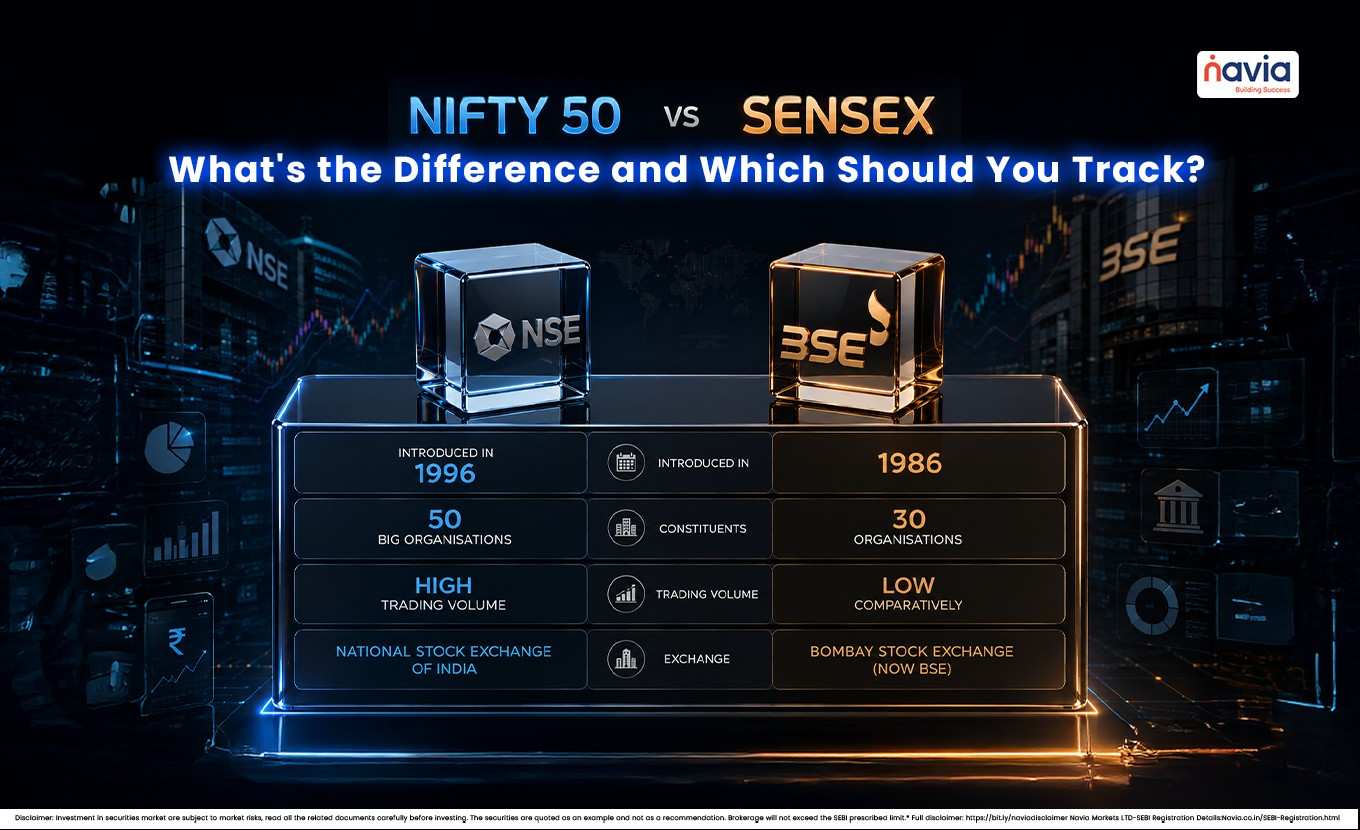
Sensex tracks 30 large companies on the BSE, while Nifty (Nifty 50) tracks 50 large companies on the NSE. Both use free-float market-capitalisation weighting and usually move in the same direction. For most retail investors, Nifty is the more practical index to track because it is the benchmark for the widest range of mutual funds, ETFs and derivatives — but there is no single “better” index.
What is Sensex?
Sensex, short for Sensitive Index, is the benchmark index of the Bombay Stock Exchange (BSE). It tracks the performance of 30 of the largest and most actively traded companies listed on the BSE. Launched in 1986, Sensex is India’s oldest stock market index and is widely used to measure the overall health of the Indian equity market.
Key Features of Sensex
- Represents 30 blue-chip companies
- Managed by the Bombay Stock Exchange (BSE)
- Covers multiple sectors of the economy
- Uses free-float market capitalization methodology
- Considered a benchmark for long-term market performance
What is Nifty?
Nifty, officially known as the Nifty 50, is the benchmark index of the National Stock Exchange (NSE). It tracks the performance of 50 large-cap companies across various sectors. The Nifty 50 is one of India’s most widely followed indices and serves as the primary benchmark for mutual funds, ETFs, and derivatives trading.
Key Features of Nifty
- Represents 50 leading companies
- Managed by NSE Indices Limited
- Provides broader market coverage
- Uses free-float market capitalization methodology
- Widely used for F&O trading and index investing

How Do Sensex and Nifty Work?
Both Sensex and Nifty are calculated using the free-float market capitalization method. This methodology considers only the shares available for public trading and excludes promoter holdings, government holdings, and other restricted shares.
Companies with higher free-float market capitalization receive greater weightage in the index. As a result, movements in heavyweight stocks such as Reliance Industries, HDFC Bank, and ICICI Bank can significantly impact both indices.
Sensex vs Nifty: Key Differences
| Feature | Sensex | Nifty 50 |
|---|---|---|
| Full Form | Sensitive Index | National Fifty |
| Exchange | BSE | NSE |
| Number of Stocks | 30 | 50 |
| Base Year | 1978–79 | 1995 |
| Base Value | 100 | 1,000 |
| Coverage | Top 30 Companies | Top 50 Companies |
| Popular Usage | Historical Market Benchmark | Trading & Fund Benchmarking |
Why Are Sensex and Nifty Important?
Sensex and Nifty act as indicators of overall market sentiment and economic performance.
| Key Function | How It Benefits Investors & the Market |
|---|---|
| Market Performance Indicator | Acts as a market barometer, helping investors quickly understand whether the overall stock market is moving upward or downward. |
| Benchmark for Investments | Serves as a standard yardstick that mutual funds, portfolio managers, and individual investors use to compare and evaluate their own investment performance. |
| Supports Index Investing | Provides the foundation for passive investing; many index funds and ETFs are built specifically to mirror the exact performance of the Sensex or Nifty. |
| Economic Health Indicator | Reflects the broader state of the Indian economy, as both indices comprise leading, heavyweight companies across major industrial sectors. |
Comparative Advantages of following Sensex and Nifty
| Advantages of Tracking Sensex | Advantages of Tracking Nifty |
|---|---|
| Long Historical Record Sensex offers one of the longest market performance records in India, providing decades of deep historical data. | Broader Market Representation Nifty covers 50 companies instead of 30, offering wider sector diversification and capturing a larger slice of the market. |
| Simplicity With a concentrated pool of only 30 companies, the index is much more straightforward for retail investors to monitor and understand. | Preferred Industry Benchmark It serves as the institutional go-to yardstick; most Indian equity mutual funds and index ETFs benchmark their performance against the Nifty. |
| Mega Blue-Chip Focus It hones in tightly on a select group of India’s most established, massive, and financially resilient mega-cap companies. | Strong Derivatives Ecosystem Nifty is the preferred choice for active traders and institutions, as it is the most extensively used index for high-volume futures and options (F&O) trading. |
Which Index Should You Track?
The choice depends on your investing style.
Track Nifty If You:
- Trade in Futures and Options
- Invest in index funds or ETFs
- Want broader market exposure
- Follow daily market movements
Track Sensex If You:
- Prefer historical market analysis
- Focus on BSE-listed companies
- Want a simpler benchmark index
For most retail investors, Nifty is generally more relevant because it is the preferred benchmark for mutual funds, ETFs, and derivatives trading.
Sensex vs Nifty: Real-Life Example
Suppose India reports stronger-than-expected GDP growth. Investors become optimistic and start buying banking, IT, and FMCG stocks. As a result:
- Sensex may rise by 500 points.
- Nifty may rise by 150 points.
Although the point of gains appears different, the percentage increase is usually very similar. This is why investors compare percentage movements rather than absolute points.
Conclusion
Sensex and Nifty are two of the most important indicators of the Indian stock market. While Sensex tracks 30 leading companies listed on the BSE, Nifty tracks 50 major companies listed on the NSE. Both indices generally move in the same direction and provide valuable insights into market sentiment and economic performance.
For most investors today, Nifty serves as the preferred benchmark because of its broader coverage and extensive use in mutual funds, ETFs, and derivatives trading. Understanding both indices can help investors make better investment decisions and stay informed about market trends.
Key Takeaways
- Sensex is the BSE’s 30-stock benchmark (launched 1986); Nifty 50 is the NSE’s 50-stock benchmark.
- Both are calculated using the free-float market-capitalisation method, so heavyweight stocks move the index the most.
- Their absolute point levels can’t be compared directly — different base years and base values — so investors compare percentage moves.
- Nifty is the more widely used benchmark for mutual funds, ETFs and derivatives; Sensex offers a longer historical record.
- To judge the companies inside an index, pair index-watching with the must-know stock market ratios.
Did you find this article helpful?
Your feedback helps us write better content.

Frequently Asked Questions (FAQs)
Is Nifty better than Sensex?
Neither is better. Nifty offers broader market coverage, while Sensex provides a longer historical perspective.
Why is Sensex higher than Nifty?
They have different base years and base values. Therefore, their numerical levels cannot be directly compared.
Can Sensex and Nifty move in opposite directions?
It is possible but rare because many large companies are included in both indices.
Which index do mutual funds generally track?
Most mutual funds, index funds, and ETFs use the Nifty 50 as their benchmark.
Which index is better for beginners?
Nifty is generally preferred because it provides broader market representation and is widely used across investment products.
DISCLAIMER: Investment in securities market are subject to market risks, read all the related documents carefully before investing. The securities quoted are exemplary and are not recommendatory. Full disclaimer: https://bit.ly/naviadisclaimer.