


Sortino Ratio: Meaning, Formula, and Why it Matters in Mutual Funds
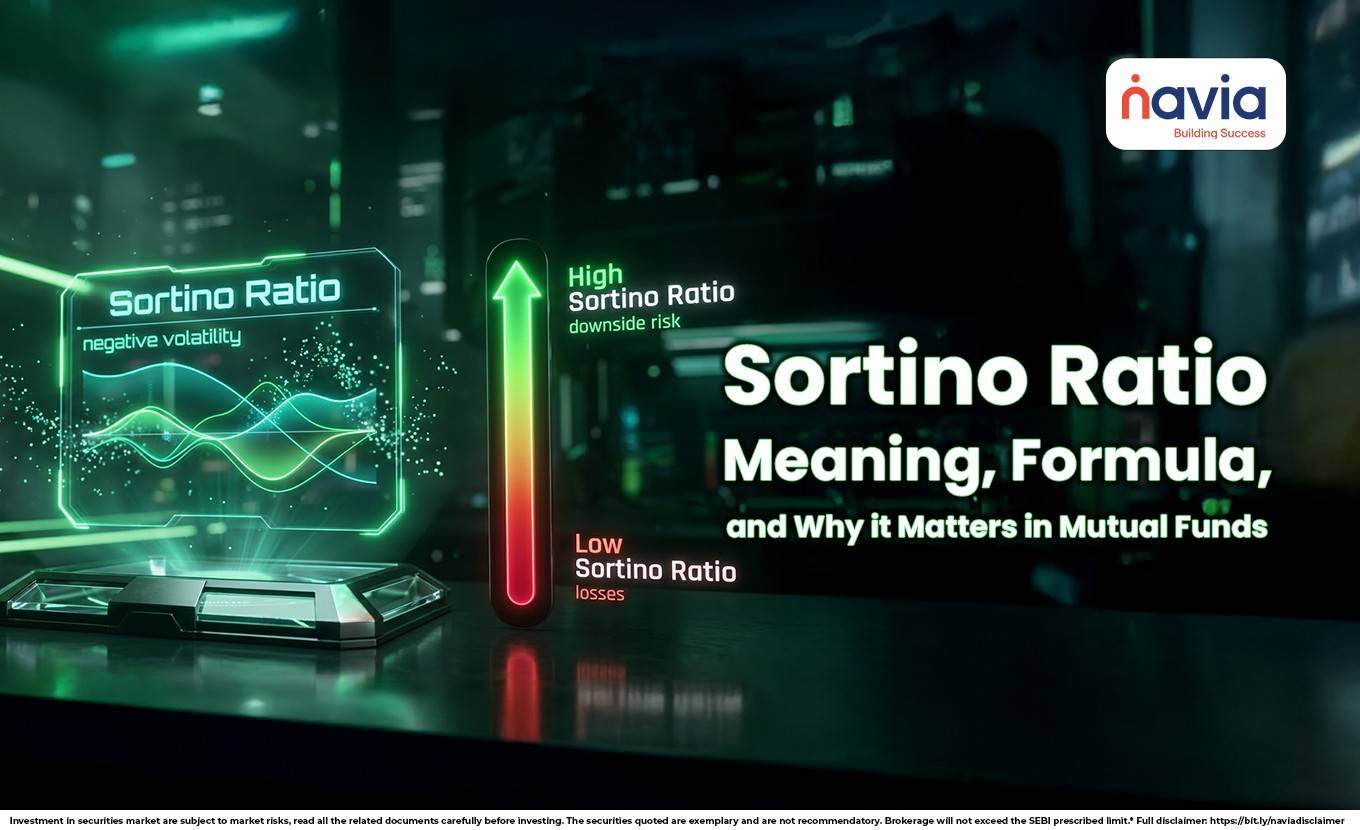
In mutual fund investing, both returns and associated risks are considered in investment evaluation. That is where the Sortino Ratio becomes useful. It helps in evaluating risk-adjusted performance in relation to downside risk levels.
Unlike other ratios that look at total volatility, the Sortino Ratio focuses only on negative movements. This makes it especially relevant for investors who care more about protecting capital during market declines than about price fluctuations of any kind.
💡 Quick Answer
The Sortino Ratio measures how much return an investment earns for the downside risk it takes. Unlike the Sharpe Ratio, which uses total volatility, it counts only harmful (negative) movements in its denominator (downside deviation). A higher Sortino generally means better return per unit of downside risk, which makes it useful for comparing mutual funds with similar returns.
What is Sortino Ratio?
The sortino ratio meaning is simple: it measures how much return an investment gives for the downside risk it carries. It is a risk-adjusted performance metric that helps in comparing returns relative to downside risk.
This ratio is useful because not all volatility is bad. Upside movement is positive, but downside movement may impact your portfolio’s value. The Sortino Ratio separates the two and provides an additional perspective on risk.
Sortino Ratio Formula
The sortino ratio formula is:
Sortino Ratio = (Portfolio Return – Risk-Free Rate) / Downside Deviation
Here:
- Portfolio Return = Return earned by the fund or investment.
- Risk-Free Rate = Return from a nearly risk-free investment.
- Downside Deviation = Measure of negative volatility only.
A higher Sortino Ratio may indicate the fund is generating a higher return relative to downside risk. A lower ratio may suggest the fund may indicate a lower return relative to downside risk for the losses it may experience.
Sortino Ratio in Mutual Funds
The sortino ratio in mutual funds is commonly used to compare schemes that may have similar returns but different risk patterns. It helps compare how funds respond to downside movements.
If two mutual funds have similar returns, the one with a higher Sortino Ratio may indicate relatively lower downside risk. This makes it a tool used by investors to evaluate return and risk characteristics between return and risk.
The Sortino Ratio is especially helpful when comparing equity funds, flexi-cap funds, or hybrid funds, where downside risk is a key consideration. It is less useful when viewed in isolation, so it should be combined with other metrics too.

Sortino Ratio vs Other Ratios
The Sharpe Ratio considers total volatility, while the Sortino Ratio focuses only on downside volatility. That makes Sortino may be relevant depending on investment objectives who want to know how much bad risk they are taking. It sits alongside the other must-know stock market ratios investors use to size up a scheme.
A fund can be volatile because it moves sharply upward and downward. Sortino ignores the upward movement and only penalizes the harmful part, which makes it more focused on downside assessment in many cases.
How Should Investors Use It?
The Sortino Ratio should not be the only factor in fund selection. Other factors may also be considered such as long-term returns, consistency, fund manager experience, expense ratio, and investment objective.
It works best as one filter in a broader evaluation process. It may assist in identifying funds with higher downside risk that may look attractive on returns but carry excessive downside risk.
Conclusion
The Sortino Ratio is one of the methods used to evaluate investment performance while focusing on downside risk. It is especially useful in mutual fund analysis because it helps investors compare funds using additional risk metrics than return alone.
For investors searching for what is Sortino Ratio, Sortino Ratio meaning, or Sortino Ratio formula, the main idea is straightforward: it helps measure how well an investment rewards you for the risk of losing money. Used carefully and along with other metrics, it can support a more comprehensive evaluation process. You can apply the same lens when comparing income funds, low duration funds and medium duration funds, or when studying company metrics like DuPont analysis.
Key Takeaways
- The Sortino Ratio is a risk-adjusted metric that measures return relative to downside (negative) risk only.
- Formula: (Portfolio Return − Risk-Free Rate) / Downside Deviation.
- It differs from the Sharpe Ratio, which penalises total volatility including the upside.
- A higher Sortino generally indicates better return for the downside risk taken.
- Use it as one filter alongside returns, consistency, expense ratio and fund objective — not in isolation.
Did you find this article helpful?
Your feedback helps us write better content.

Frequently Asked Questions
What is Sortino Ratio?
The Sortino Ratio is a risk-adjusted return metric that measures return relative to downside risk.
What does Sortino Ratio mean in simple words?
It means how much return an investment gives compared to the bad risk or losses it may cause.
What is the Sortino Ratio formula?
The formula is: (Portfolio Return – Risk-Free Rate) / Downside Deviation.
Why is Sortino Ratio useful in mutual funds?
It helps investors compare mutual funds based on downside risk assessment, not just total returns.
Is Sortino Ratio better than Sharpe Ratio?
It depends on the goal. Sortino may be preferred in scenarios focused on downside risk for investors who want to focus only on downside risk.
DISCLAIMER: Investment in securities market are subject to market risks, read all the related documents carefully before investing. The securities quoted are exemplary and are not recommendatory. Full disclaimer: https://bit.ly/naviadisclaimer.