

Large, Mid, and Small Cap Funds: A Complete Comparison

If we are talking about mutual fund investing, one of the most important for investors is the selection of large cap, mid cap or small cap funds. Each of these categories has its own risk, investment style and return potential. To make smarter investment choices, it is necessary to understand the difference between large cap, mid cap and small cap fund.
The blog will provide you with a complete comparison of large cap, mid cap and small cap funds while highlighting their characteristics, advantages and risks.
💡 Quick Answer
The three categories are defined by where a company sits in the market-capitalisation ranking, not by any judgement about quality. Large cap funds hold companies ranked 1 to 100 and offer stability, the lowest relative risk, and high liquidity. Mid cap funds hold companies ranked 101 to 250 and sit between the two on both risk and return. Small cap funds hold companies ranked 251 and beyond, with the highest growth potential, the highest volatility, and comparatively lower liquidity. In short: large cap equals stability, midcap equals balance, small cap equals growth plus risk. Most investors are better served by a diversified mix than by choosing one.
What are Large, Mid, and Small Cap Funds?
Before diving into the deep comparison about them, let’s clarify the basic definitions of large, mid and small cap funds. These category boundaries are set by the Securities and Exchange Board of India (SEBI) and applied uniformly across fund houses.
Large Cap Funds
It includes the companies that ranked 1 to 100 in terms of market capitalization, and they are usually established companies with stable earnings.
Mid Cap Funds
These companies are ranked 101 to 250, and they have a decent growth potential and are less risky compared to small caps but risky than large cap funds.
Small Cap Funds
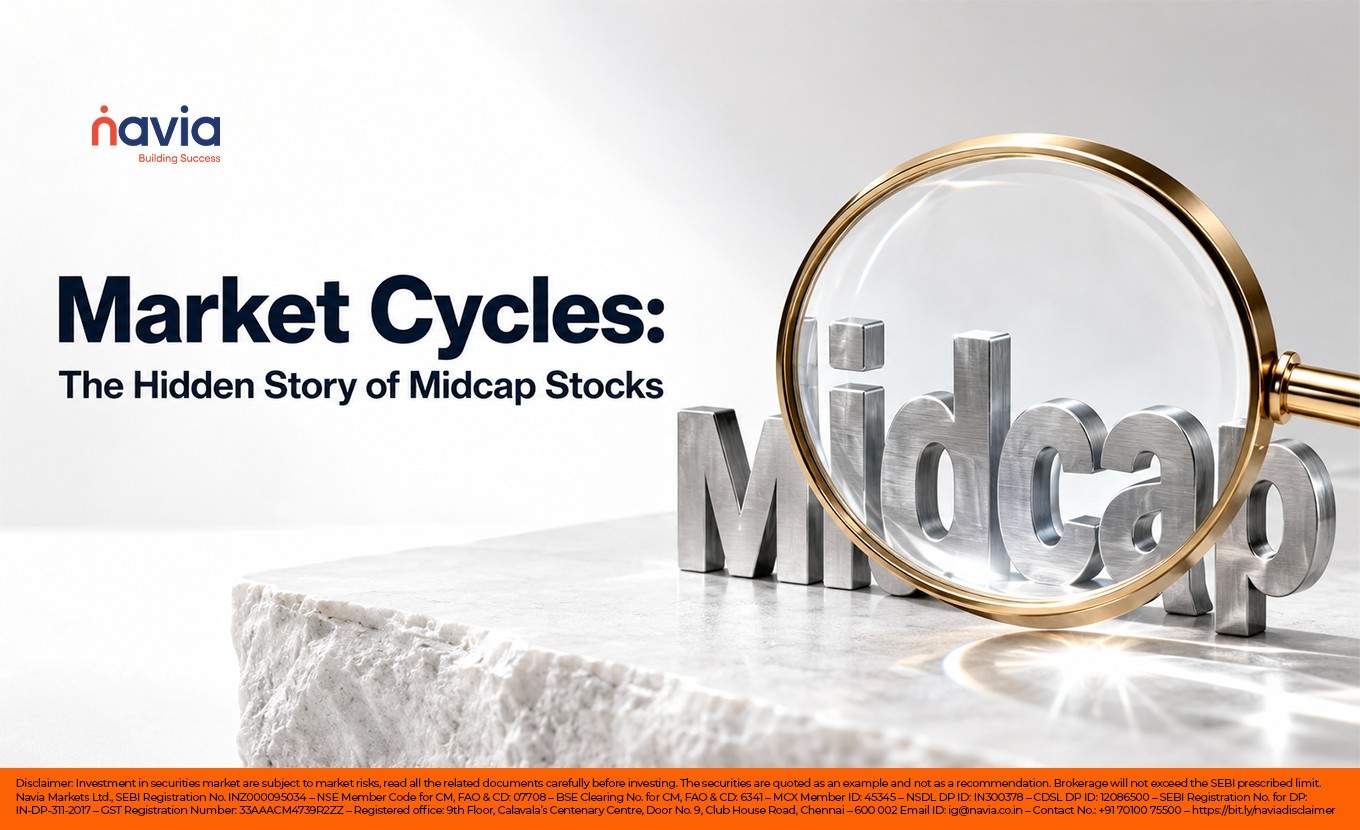
Small cap funds include the companies that are ranked 251 and beyond and these companies are with high growth potential and high volatility.
In short sentence we can say that:
- Large Cap = Stability
- Midcap = Balance
- Small Cap = Growth + Risk
Advantages of Large, Mid, and Small Cap Funds
| Small Cap | Mid Cap | Large Cap |
|---|---|---|
| High growth and multibagger potential | Balance of growth and stability | Stable and reliable performance |
| Best for aggressive investors willing to take risks | Suitable for investors with moderate risk appetite | Suitable for conservative investors |
| Suitable for long-term wealth creation if held through market cycles | Opportunity to benefit from companies moving toward large-cap status | Great for building a strong core portfolio |
| Early investment in future large businesses | Higher return potential than large caps | Lower risk due to established companies |
| Diversification benefits due to untapped market opportunities | Can outperform in bullish market cycles | Strong track record and consistent dividends |

Large Cap vs Mid Cap vs Small Cap: Key Differences
Understanding the major difference between small cap, mid cap and large cap funds is an essential part for investors who are seeking growth and safety. Let’s look at the major aspects;
| Aspects | Small Cap | Mid Cap | Large Cap |
|---|---|---|---|
| Regulatory Classification (SEBI) | Companies ranked 251 and beyond | Ranked 101st–250th companies | Ranked 1 to 100 companies |
| Risk and Volatility | High risk and volatility | Moderate risk | Lowest risk |
| Return Potential | Deliver multibagger returns but also large losses if markets crash | Higher returns but riskier | Steady but moderate returns |
| Liquidity | Relatively lower liquidity compared to large/mid-caps | Reasonably liquid but not as much as large caps | Highly liquid |
| Market Performance | Outperform during bull markets when growth is in demand | Outperform during bull markets when growth is in demand | Offer resilience during market downturns and steady performance in bull markets |
| Investor Profile | Aggressive investors | Moderate risk-takers | For long-term stability seekers |
| Best For | High-risk, high-reward opportunities | Balanced growth and risk | Wealth preservation, steady growth |
Whichever category you lean towards, the cost of holding it compounds too — expense ratios explained shows how much a fee difference matters over a long horizon, and understanding NAV covers how your units are actually priced.
Who Should Invest?
Large Cap Funds
If you are seeking stability, less volatility and long-term returns, large cap funds are the best option for you. Mostly these types of funds are chosen by retirees, risk-averse investors and the people who are focusing on a steady investment.
Mid Cap Funds
If you have moderate risk appetite and are searching for medium-to-long investment option mid cap funds are the best. Because they give a perfect balance between growth and security. It is most suitable for salaried professionals and the people who are aiming for better-than-average returns.
Small Cap Funds
If you have a high-risk appetite and an aggressive investor with a strong long-term horizon in mind, small cap funds are the best. These funds are rewarding you with substantial growth and are ideal for young investors. Because that horizon has to be sat through, a Systematic Investment Plan rather than a lumpsum is often the gentler way in, and smart investing: which SIP is right helps pick the variant.
Final Thoughts
The difference between large cap, mid cap and small cap funds is very important for all investors. Large cap funds provide stability; mid-caps are offering balance and small cap funds bring aggressive growth opportunities. Instead of focusing only on one, you must create a diversified portfolio that combines with large, mid and small cap funds to balance safety and growth. But remember that the choice completely depends on your financial goals, risk appetite and time horizon.
If you are still deciding how to shortlist inside any one of these categories, a beginner’s guide on how to choose mutual funds sets out the full process, and the exit load and lock-in period explains what it costs to change your mind.
Ready to explore large cap, mid cap, and small cap funds? Begin your journey by opening free demat account!
Key Takeaways
- The three categories are a ranking rule, not a quality rating — large cap is 1 to 100, mid cap is 101 to 250, and small cap is 251 and beyond by market capitalisation.
- Because the boundary is regulatory and uniform, a “large cap fund” means the same universe of companies at every fund house.
- Large cap equals stability and high liquidity; midcap equals balance; small cap equals the highest growth potential paired with the highest volatility.
- Liquidity, not just volatility, is the underrated small cap risk — it is hardest to exit precisely when you most want to.
- Picking one category is rarely the right answer. A deliberate mix across all three, sized to your horizon and risk appetite, is what balances safety against growth.
- Related reading: how to choose mutual funds, SIP vs lumpsum, expense ratios explained, and SIP, STP, and SWP.
Did you find this article helpful?
Your feedback helps us write better content.

Frequently Asked Questions
Which is better to invest, large-cap, mid-cap, or small-cap?
It depends on your risk appetite and financial goals. Large-cap funds are safer and stable, mid-cap funds offer a balance of risk and growth, while small-cap funds carry higher risk but can generate the highest returns.
What is a good mix of large, mid, and small cap?
It completely depends on the individual’s risk tolerance, financial goals, and investment horizon. A common allocation strategy is 50% large-cap, 30% mid-cap, and 20% small-cap for a balanced portfolio.
Which cap size gives the best returns?
Historically, small-cap funds have delivered the highest returns due to their growth potential, but they also carry the most risk. Mid-cap funds strike a balance, while large-cap funds provide steady and consistent returns with lower volatility.
Is multi cap better than small cap?
Yes, multi-cap funds are generally better for most investors because they diversify across large, mid, and small-cap stocks, reducing risk.
Which is more aggressive, small-cap or large-cap?
Small-cap funds are more aggressive because they invest in young and growing companies with high return potential but higher volatility. Large-cap funds are relatively conservative, focusing on established companies with stable performance.
DISCLAIMER: Investments in securities market are subject to market risks, read all the related documents carefully before investing. The securities quoted are exemplary and are not recommendatory. Full disclaimer: https://bit.ly/naviadisclaimer.