


Bull Vs Bear Market: Key Differences and Investment Tips
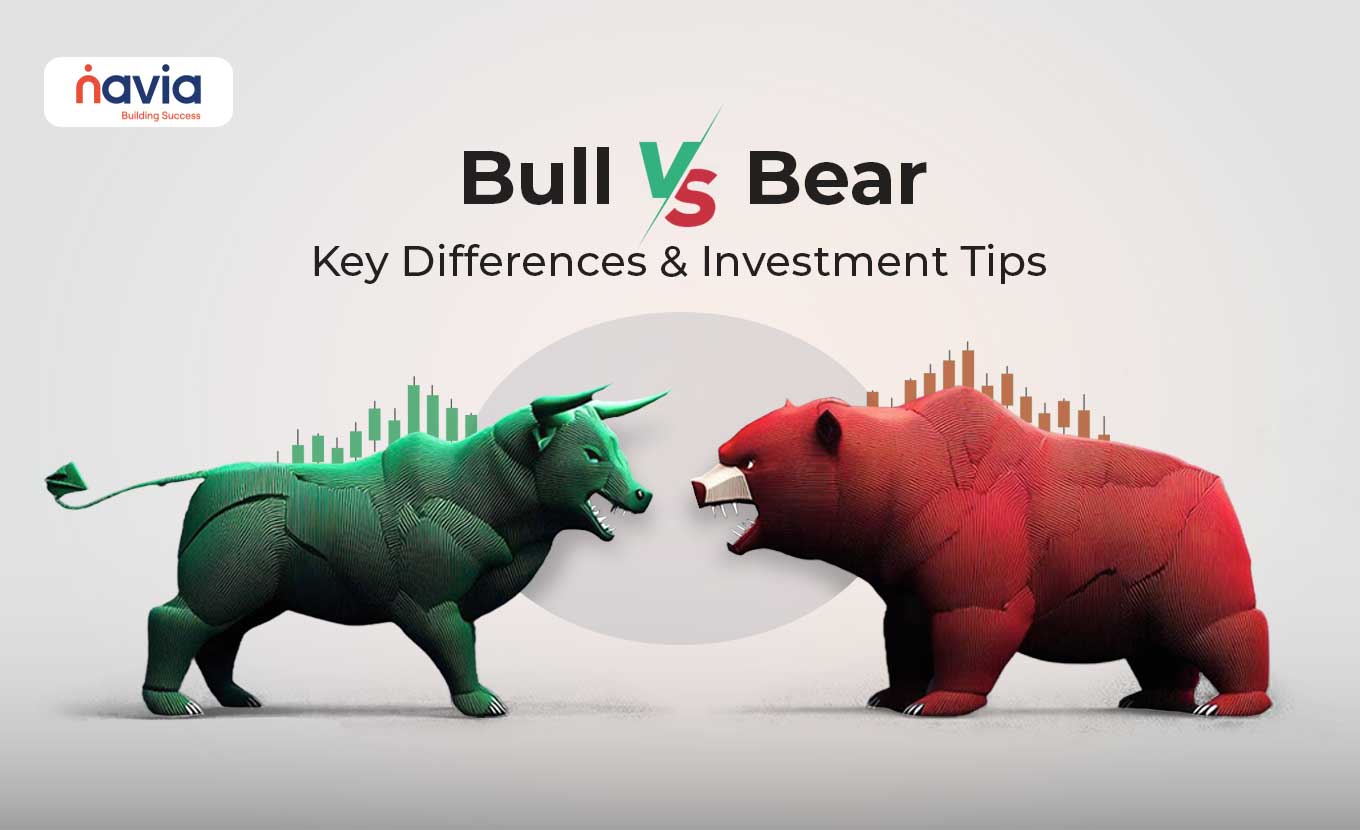
In the stock market, every investor has to navigate the ever-shifting terrain of the bull and bear market. These two phases describe very different economic outlooks and investor behaviours, and they are essential terms for anyone who invests. Whether you are new to the market or honing an existing strategy, it pays to understand how to operate in both bull and bear market phases.
Here is a comprehensive guide to recognizing market moods, understanding bull market vs bear market, and adjusting your investment approach accordingly.
💡 Quick Answer
A bull market is a sustained rise in stock prices backed by strong economic indicators and growing corporate earnings. A bear market is conventionally defined as a fall of 20% or more from recent highs, alongside an economic slowdown and weak sentiment. Both are cyclical, and each rewards a different playbook — growth and accumulation in a bull phase, defensive positioning and staggered entries in a bear phase.
What Do Bull and Bear Mean in the Stock Market?
Many people are unsure of the exact meaning of bull and bear market, but the terms are simple. A bull market refers to a sustained period where overall stock prices are rising, supported by strong economic indicators and rising corporate earnings. Conversely, a bear market signals a decline of 20% or more, an economic slowdown and falling investor confidence.
These trends are like two sides of a coin; each presents distinct opportunities and risks for investors. Before diving into the investing world, you should understand the differences between them. If some of the vocabulary is new, our glossary decoding Dalaal Street covers the essential stock market terms.
Similarities Between Bull and Bear Markets
We have seen that bull and bear phases differ in direction, but they share certain characteristics too. Let’s see what they are.
- Both are influenced by economic conditions such as GDP, investor confidence and interest rates.
- Investor psychology plays a major role in both scenarios, often amplifying market moves through FOMO in bull markets or panic selling in bear markets.
- Neither phase lasts forever. It is the cyclical nature of markets that opens the door to strategic investing across both.
Sharp moves in either direction can also hit exchange-level limits, which is why it helps to know how stock circuits halt prices.

Differences Between Bullish and Bearish Market
| Aspect | Bull Market | Bear Market |
|---|---|---|
| Direction of the Market | Rising stock prices | Falling stock prices |
| Stock Performance | Stock price rise by 20% | Stock price decline by 20% or more |
| Investor Sentiment | Confident, happy | Fearful, afraid to invest more |
| Economic Conditions | Growth, rising corporate earnings | Economic slowdown, high volatility, weak earnings |
| Volatility | Relatively lower | Higher |
| Time Frame | Last for few months to years | Last for few months to years |
| Typical Strategy | Growth investing, accumulating equities | Defensive positioning, seeking discounted entry points |
| Launch of Initial Public Offerings (IPOs) | Ideal for IPO launching | Not ideal for IPO launching |
| Interest Rates | Low or stable | Rise |
How to Invest in a Bull Market Vs Bear Market?
Investing strategies depend on whether you are in a bull or a bear market. Below are some approaches that will help you navigate each one. If you are still getting your bearings, start with stock trading explained.
Investing in Bull Market
When the market is rising, it is a bull market: investor confidence is high and so are stock prices. You still need a strategy to manage it effectively, and some of the options are listed below.
- In bull markets, many investors prefer long-term holding strategies, focusing on growth-oriented companies.
- Focus on companies that are growing quickly, since they tend to perform well during economic expansions.
- Diversifying your portfolio still matters in a bull market, so spread your investments across various sectors and stocks.
- If you hold dividend-paying stocks, reinvesting the dividend helps your portfolio compound while still generating income.
Investing in Bear Market
When prices are falling and investor sentiment is negative, we call it a bear market. Let’s see how to navigate this harder phase.
- Shifting part of your investments to bonds or fixed-income securities can offer stability.
- Dividend-paying stocks continue to provide a steady income even when prices fall.
- Hedging strategies using instruments such as ETFs and Options can protect your investment from market downturns.
- Invest in companies that provide essential goods and services, such as healthcare and consumer staples, because they tend to hold their value better during economic slowdowns.
Conclusion
Understanding the bear versus bull market and knowing how to invest in both will help seasoned and new investors alike. To make better decisions you need both the energy of a bull and the caution of a bear. Market cycles repeat; the investors who prepare their strategies in advance are the ones who stay ahead.
Whether it’s a bull or bear market, investors should rely on disciplined strategies, research, and long-term goals to navigate effectively.
Key Takeaways
- A bull market is a sustained rise in prices; a bear market is conventionally a fall of 20% or more from recent highs.
- Both phases are shaped by GDP, interest rates and investor psychology, and neither lasts forever.
- Bull markets favour growth investing, accumulation and dividend reinvestment.
- Bear markets favour defensive positioning, fixed income, hedging and staggered entries at discounted prices.
- FOMO buying in a bull phase and panic selling in a bear phase are the two most expensive behavioural mistakes.
- No one can predict a turn with certainty, but inflation, earnings trends and confidence data give early hints.
Did you find this article helpful?
Your feedback helps us write better content.

Frequently Asked Questions
What is the difference between a bear market and a bull market?
A bull market refers to a period when stock prices rise steadily, reflecting investor optimism, strong economic growth, and higher corporate earnings. A bear market, on the other hand, is when stock prices fall by 20% or more from recent highs, often driven by pessimism, economic slowdown, or uncertainty.
How can beginners understand bull/bear markets?
Beginners can understand bull and bear markets by observing market trends and investor behavior. In a bull market, there is rising demand for stocks, high trading volumes, and increasing prices. In a bear market, prices fall consistently, selling pressure increases, and investors move to safer assets.
How to predict bear market?
While predicting a bear market with certainty is impossible, investors can watch for warning signals such as:
- Rising inflation and interest rates
- Weakening corporate earnings
- Global or domestic economic slowdown
- High levels of market speculation followed by corrections
- Declining investor confidence
Using technical indicators (like moving averages) and economic indicators (like GDP growth and unemployment data) can also provide early hints.
What is FOMO buying?
FOMO (Fear of Missing Out) buying happens when investors rush to buy stocks simply because others are buying and prices are rising. Instead of making informed decisions, they follow the crowd, fearing they will miss profits.
What are the signs of a bull market?
A bull market usually shows these signs:
- Consistently rising stock prices
- High investor confidence
- Increased corporate earnings
- Strong economic indicators (GDP growth, low unemployment, stable inflation)
- Higher trading volumes and IPO activity
How to determine bull or bear market?
To determine whether it’s a bull or bear market, look at market performance over time. Compare the headline indices — the Nifty on the NSE and the Sensex on the BSE — against their recent extremes:
- If stock indices (like Nifty or Sensex) rise 20% or more from recent lows, it signals a bull market.
- If indices fall 20% or more from recent highs, it indicates a bear market.
DISCLAIMER: Investments in securities market are subject to market risks, read all the related documents carefully before investing. The securities quoted are exemplary and are not recommendatory. Full disclaimer: https://bit.ly/naviadisclaimer.