

Market Volatility: Understanding Market Movements During Periods of Uncertainty

- Lessons from a Legend: Sir John Templeton
- The 2026 Context: History Repeating Itself?
- NIFTY 50 Reacts to Global Crises
- A Timeline of Resilience: How Markets Bounce Back
- Logic Over Emotion: Your Action Plan
- The Bottom Line
- Frequently Asked Questions
If you are a teenager just starting to learn about money or a retiree managing a lifelong nest, market declines can create uncertainty for investors. The news headlines are talking about the war and economic crisis; many investors may feel inclined to reduce exposure during periods of volatility.
But in investing, the most successful people are often those who can stay calm when everyone else is panicking. In this blog, we navigate the turbulent waters of March 2026. It’s time to take a deep breath and look at the bigger picture.
Lessons from a Legend: Sir John Templeton
To understand how to handle today’s market, first you must look back at one of the greatest investors of the 20th century: Sir John Templeton. In 1939, at the outbreak of World War II, most people were selling everything they owned. But Templeton did the opposite; and his simple idea is “buy at the point of maximum pessimism”.
He borrowed money to buy 100 shares of every company on the New York Stock Exchange. While it looked like a reckless gamble to others, it was a calculated bet that the world would eventually recover. He was right actually; only four of his picks failed, but the rest delivered significant returns over time.
The 2026 Context: History Repeating Itself?
Fast forward to March 2, 2026. The headlines feel just as grim, following U.S. and Israeli strikes on Iran. This geopolitical tensions in the Middle East reached a boiling point, in response, the Indian stock market (nifty) has plummeted over 1,000 points in just three trading sessions.
It is uncomfortable for everyone; fear is designed to make us act impulsively. But if we look at history, we can find a pattern: Geopolitical events often lead to short-term market volatility.
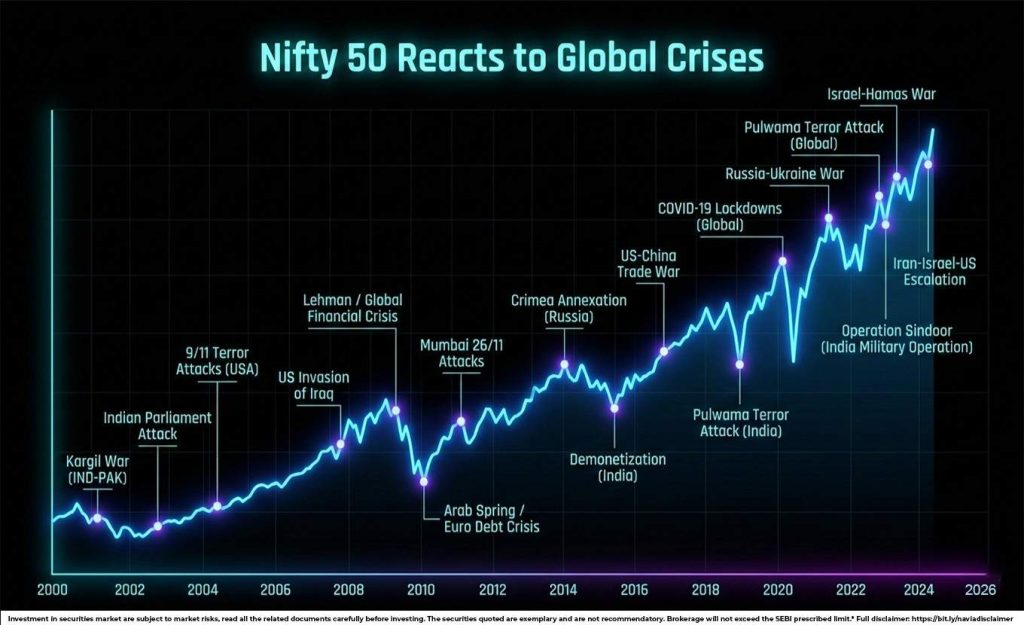
NIFTY 50 Reacts to Global Crises
A Timeline of Resilience: How Markets Bounce Back
History is the best teacher. Looking at past crises, we can see that the “initial shock” hurts; markets have historically stabilized after periods of volatility.
Major Indian Geopolitical Events
India has faced numerous local crises that temporarily rattled the markets, only to see them soar later:
🔹 The Kargil War (1999)
🔹 The Parliament Attack (2001) & Mumbai 26/11 (2008)
🔹 Surgical Strikes (2016 & 2019)
🔹 Operation Sindoor (May 2025)
Global Shocks and Recoveries
🔹 COVID-19 (2020): A global shutdown caused a massive crash, yet markets recovered over time as economic conditions improved.
🔹 Russia-Ukraine War (2022): Despite the tragedy, markets stabilized quickly once the economic impact was understood.
🔹 Gaza Conflict (2023-25): Interestingly, many indices rose nearly 10% in the three months following the initial conflict.
🔹 Iran-Israel Mini-War (Mid-2025): We saw a “risk-off” move where money flowed into Gold and Oil, but equities rebounded shortly after.

Logic Over Emotion: Your Action Plan
Some investors review valuations during periods of market decline. They will separate the price (what they paid) from value (what the company is actually worth). But considering that being brave doesn’t mean being reckless; you don’t have to throw all your money into the market at once while the situation is hot.
The Staggered Entry Strategy (The 4-Leg Approach)
Instead of trying to time the exact bottom, consider deploying your capital in phases. A common strategy is the 25% rule (education purpose only).
➣ Phase 1: Some investors choose to allocate investments gradually over time.
➣ Phase 2: Invest another 25% if the market dips further.
➣ Phase 3 & 4: Deploy the remaining halves as the situation stabilizes.
This way, if the market bounces back early, you already have market exposure. If it falls more, you have “ammunition” left to review investment allocations depending on market conditions.
The Bottom Line
The difference between those who regret a crisis and those who remain disciplined during periods of volatility, usually comes down to one control that is emotion. The current situation of the U.S., Israel and Iran is still unfolding, it is a serious and caution is warranted. But remember the world has faced “the end of the world” many times before, and the markets have historically experienced periods of recovery.
So, stay calm, logical, and remember that market movements can change over time as conditions evolve.
Do You Find This Interesting?
We’d Love to Hear from you-

Frequently Asked Questions
Does war make stocks go up or down?
Market history shows that major indexes are more reliable guides than geopolitical headlines. Markets may experience volatility during geopolitical events depending on economic conditions.
How does war affect the Indian stock market?
Geopolitical shocks typically trigger rapid, short-term volatility in Indian equities, as seen during the Russia-Ukraine crises. While the Nifty often corrects sharply in the initial sessions, it historically stabilizes once market clarity emerges. For investors, the ultimate question is whether to react to the noise or wait for the recovery.
How is India affected by the Iran war?
The Middle East conflict has spiked oil prices by 15% and disrupted gas flows, triggering a broad sell-off in Indian markets. Consequently, the rupee has hit record lows while bond yields have climbed, fueled by fears of a widening current account deficit and surging inflation.
Which sector benefits from war?
During geopolitical instability, defense sector stocks may experience increased attention during geopolitical developments. Heightened conflict drives governments to expand military budgets for weaponry, logistics, and cybersecurity, providing firms with long-term revenue visibility through massive procurement contracts.
DISCLAIMER: Investments in the securities market are subject to market risks, read all the related documents carefully before investing. The securities quoted are exemplary and are not recommendatory. Brokerage will not exceed the SEBI prescribed limit.