


Notional Exposure and Leverage Explained: A Guide for Modern Investors
- What is a Notional Exposure?
- What is a Leverage Exposure?
- Notional Value and Leverage: The Connection
- Why Notional Exposure Matters Risk Management?
- Conclusion
- Frequently Asked Questions
In the trading landscape of April month, Indian investors are increasingly utilizing derivatives to navigate volatility in the Nifty 50 and commodity markets. The two terms are more important: Notional Value and Leverage. They are frequently used interchangeably; understanding the distinction is vital for effective risk management.
If you are actively trading on futures, options or other derivative instruments, having notional exposure and leverage explained is the first step toward protecting your capital.
What is a Notional Exposure?
To understand the mechanics of a trade, you must first ask, what is notional exposure? In simple words, notional exposure refers to the total value of the assets controlled by a derivative contract. Unlike cash market trade, derivative allows you to control a large position with a much smaller upfront payment.
The Notional Value is the total underlying value that your contract represents. If you hold a futures contract for 500 shares of a company trading at ₹1,000, your notional exposure is ₹5,00,000, even if you only paid a small margin to open the position.
What is a Leverage Exposure?
We can say that the second pillar of the concept is leverage; the leverage exposure meaning refers to the use of borrowed capital or specialized financial instruments to increase the potential return of an investment.
If you use leverage, you are essentially amplifying your market presence. By only putting up a fraction of the total trade value, you gain exposure to the price of movements of the entire notional amount. This is why small price fluctuations in the underlying asset can lead to significant percentage gains or losses in your actual invested capital.
Notional Value and Leverage: The Connection
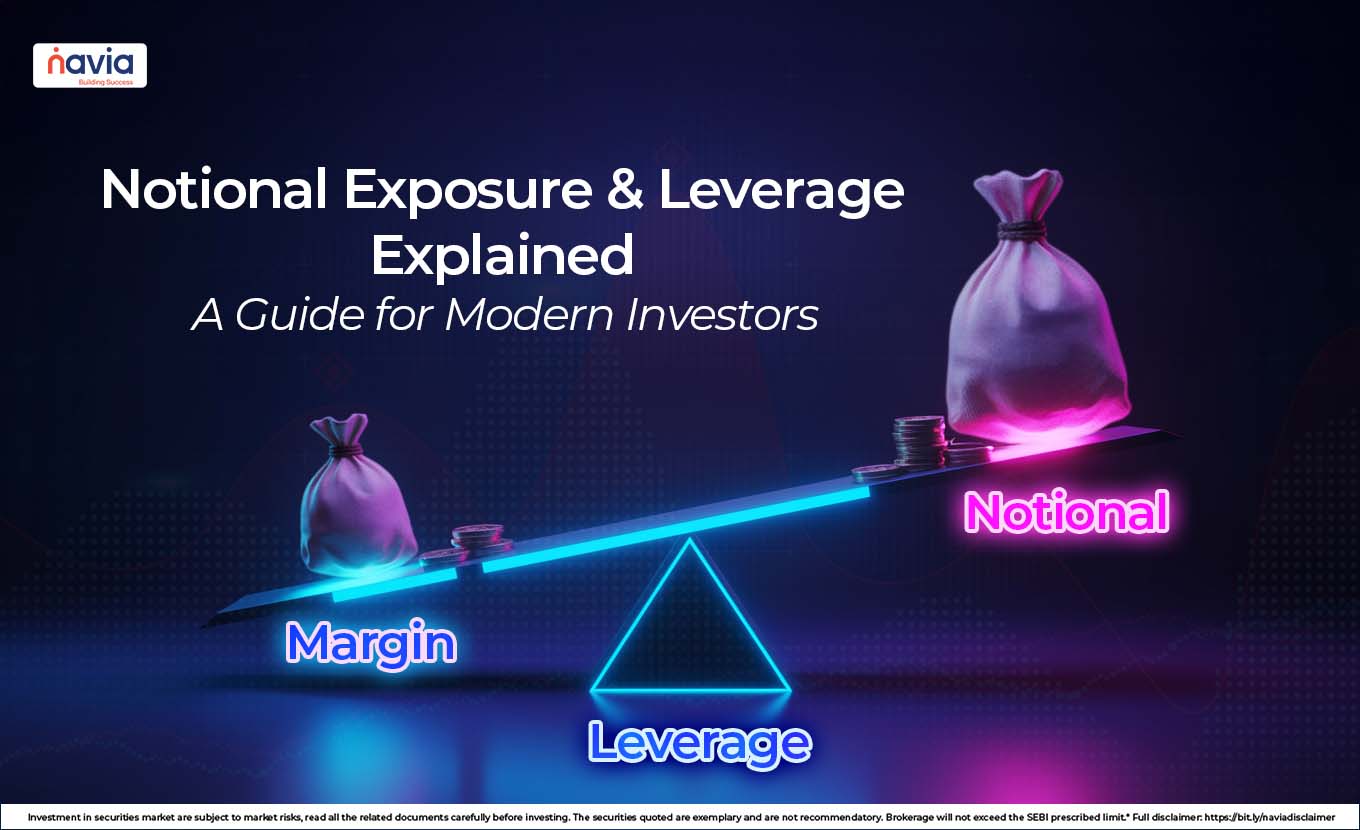
The relationship between notional value and leverage is mathematical. Leverage is the ratio of the total notional exposure to the margin or equity held in the account.
Let’s see the formula;
Leverage = Notional Value / Equity (Margin)
For example, if you have ₹1,00,000 in your trading account and you take a position with a notional value of ₹10,00,000, you are using 10x leverage. Understanding this connection is important because it indicates the overall size of the position. In some cases, traders may focus only on margin balance, forgetting that their actual market risk is tied to the much larger notional amount.
Why Notional Exposure Matters Risk Management?
Proper notional exposure and leverage explained wouldn’t be complete without discussing risk limits. Professional traders use notional value to determine their overall position size.
| Portfolio Concentration | By calculating the notional value of all open positions, you can see if you are over-exposed to a single sector, such as PSU Banks or Energy. |
| Volatility Adjustment | In high-volatility periods like April 2026, some investors may reduce their leverage exposure to manage the impact of sharp price movements. |
Conclusion
These concepts are commonly used in trading analysis, by recognizing that your market risk is defined by your notional exposure rather than just the cash in your account, this can aid in understanding portfolio exposure.
As you continue to explore advanced trading strategies, it is useful to consider notional exposure.
Do You Find This Interesting?
We’d Love to Hear from you-

Frequently Asked Questions
How does notional value affect leverage?
Notional value is a staple concept in the derivatives market, primarily because these financial instruments allow leverage usage. Through leverage, market participants can enable exposure to larger positions with margin requirements of upfront capital. In these scenarios, the notional value serves as the metric for the total market value of the larger position being controlled.
What does 20% leverage mean?
A leverage ratio quantifies the amount of borrowed capital utilized in a specific trade. For example, a 20:1 ratio indicates that for every ₹1 deposited as margin, you command a position worth ₹20. In a scenario like trading EUR/USD, providing a 5% margin equates to a leverage ratio of 20:1.
Who uses notional value?
Crucial for derivatives, futures, options, and swaps, notional value represents the total underlying worth of a contract. It provides a measure of a position’s overall scale and market exposure, distinct from the actual capital or margin exchanged between parties.
Is 5x leverage risky?
Utilizing 5x leverage involves a higher risk profile compared to lower leverage levels. Although this strategy can increase exposure to price movements, it equally magnifies the impact of losses should the market trend against you. It is important to understand these heightened risks before committing to 5x leveraged trades.
How to calculate notional value?
To determine the notional value, you multiply the current market price of the underlying asset by the total number of units specified in the contract. Rather than reflecting the initial margin or cost, this figure represents the comprehensive value of a leveraged position, such as a futures or options contract.
Notional Value = Contract Size * Underlying Asset Price
DISCLAIMER: Investment in securities market are subject to market risks, read all the related documents carefully before investing. The securities quoted are exemplary and are not recommendatory. Full disclaimer: https://bit.ly/naviadisclaimer.