

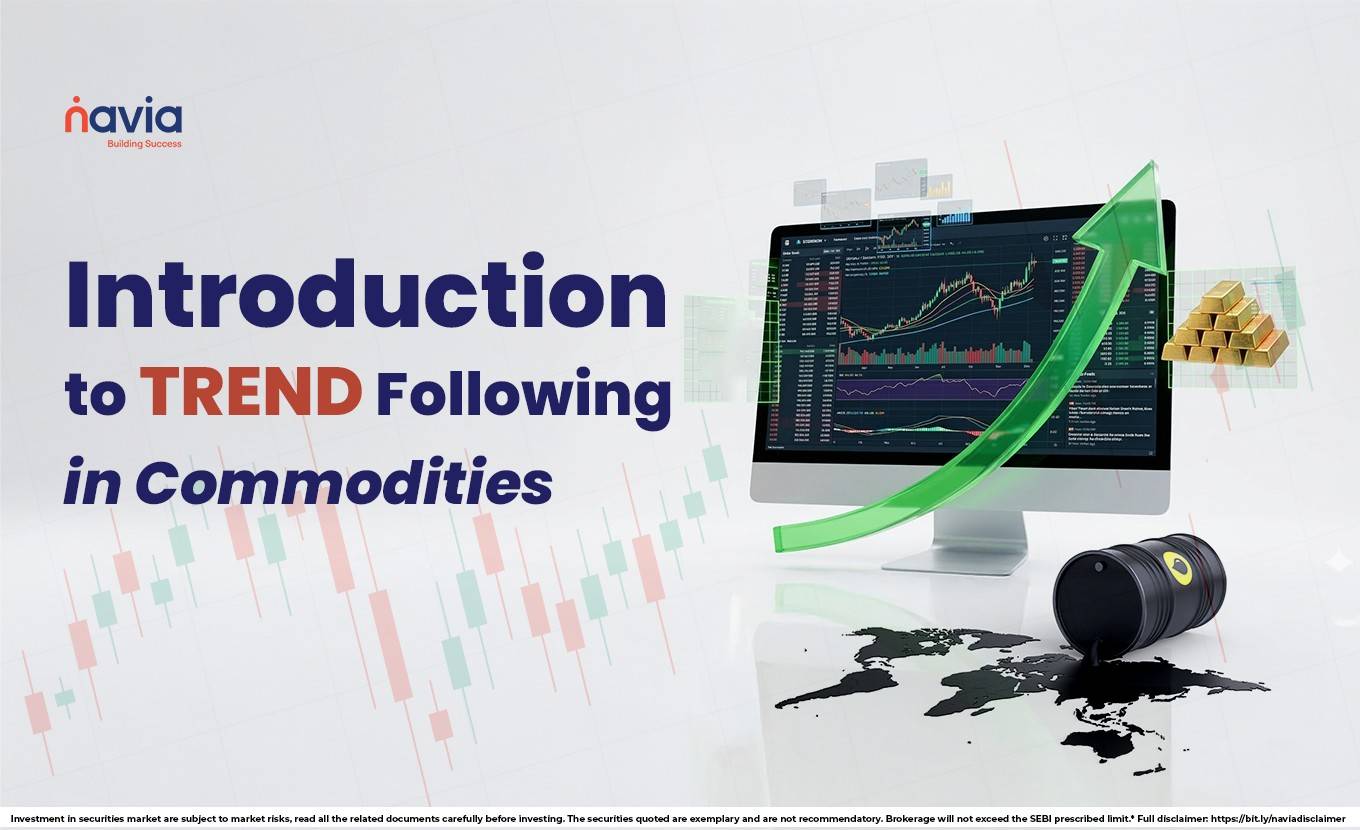
Introduction to Trend Following in Commodities
- Understanding the Commodity Landscape in India
- The Trend of Commodity Prices: Why They Move So Strongly
- What is Trend Following?
- How to Build a Trend Following System?
- Conclusion
- Frequently Asked Questions
In the world of investing, few things are as psychologically challenging, yet widely studied in trading methodologies. Most investors are taught to “buy low and sell high” but trend followers operate on a different philosophy; “enter positions in the direction of an existing trend”. In the Indian financial landscape this strategy has found its commonly applied in commodities markets.
Unlike equities which often rely on quarterly earnings and corporate governance, commodities move based on the raw, undeniable laws of supply and demand. In this blog, we will explore the trend of commodity prices, the structure of the Indian market and how traders analyze price momentum.
Understanding the Commodity Landscape in India
Before diving into the strategy, it is necessary to understand the playing field. India has a regulated ecosystem for commodity trading. So, let see how many commodities are traded in India;
India’s primary commodity exchanges like MCX (Multi Commodity Exchange) and NCDEX (National Commodity & Derivatives Exchange) offer a diverse range of products. The commodities traded in India is depends on the exchange, but they generally fall into four major categories, they are;
🔸 Bullion: Gold and Silver
🔸 Energy: Crude Oil and Natural Gas
🔸 Base Metals: Copper, Aluminum, Zinc, and Lead
🔸 Agri-Commodities: Cotton, Mentha Oil, Guar Seed, and various spices
We saw the major categories, now you have the doubt of which authority regulates commodity trading in India? It’s a common question for new entrants. The answer is the market is not controlled by any single entity but is strictly regulated by the Securities and Exchange Board of India (SEBI). SEBI ensures fair price discovery, transparent trading practices, and risk management across all exchanges.
In short, the exchanges provide the platform, but the actual prices are driven by global supply chains, geopolitical events, and domestic consumption.
The Trend of Commodity Prices: Why They Move So Strongly
The trend of commodity prices is often analyzed using trend-following approaches because raw materials often undergo “extended price movements in one direction.” These aren’t just random fluctuations; they are the result of deep-seated economic shifts.
| Seasonality | Natural gas often spikes in the winter due to heating demand, while agricultural products trend based on harvest cycles. |
| Geopolitics | Crude oil is famous for massive rallies when supply routes are disrupted, or global production is cut. |
| Economic Cycles | Gold often enters long-term uptrends during “risk-off” periods when investors flee from volatile stock markets. |
These factors take time to play out; a commodity price trend can last week, months, or maybe multiple quarters.
What is Trend Following?
The trend following is a systematic trading approach where the traders confirm the current direction of the market and identify trends and observe price movements during those trends. So, the main goal is, you aren’t trying to predict the exact bottom or the perfect top, instead you aim to participate in part of the price movement.
Let’s see the three core principles of trend following;
| Price is the Primary Signal | You don’t need to be a meteorologist to trade wheat or a geopolitical expert to trade oil. Some trend following approaches involve taking positions in the direction of price movement. |
| Losses are Controlled Early | Trend followers accept that markets only trend about 30% of the time. They are happy to take frequent small losses (stops) while waiting for that one massive trend to emerge. |
| Profits are Allowed to Run | The biggest mistake beginners make is cutting their winners too early. In commodity trend following, trend-following strategies may involve multiple small losses and occasional larger price movements. |
How to Build a Trend Following System?
A complete system requires three things; Entry, Exit, and Position Sizing. Here you can see more about the aspects (for educational purposes only).
| Entry | Don’t jump in just because you feel a trend. Use a trigger. Some traders monitor price levels such as recent highs when analyzing trends. |
| Exit | You must have an exit plan before you enter. Some traders use reference levels such as recent price points when managing risk. |
| Position Sizing | In commodities, volatility plays an important role. If you are trading a highly volatile asset, your position size should be smaller than if you were trading a more stable asset. It ensures a position sizing may help manage overall trading risk. |
Conclusion
Trend following in commodities isn’t about having a crystal ball; it’s about having a set of rules and the discipline to follow them. By focusing on the trend of commodity prices rather than predicting the future, you analyze market movements influenced by broader economic factors.
Whether you are trading gold, crude oil, or zinc, remember the secret remains the same, risk management and disciplined trading practices are often emphasized in trend-following approaches.
Do You Find This Interesting?
We’d Love to Hear from you-

Frequently Asked Questions
Are commodity prices going up or down?
Projections from the S&P Goldman Sachs Commodity Index indicate expected changes based on available forcasts for the raw materials sector, with an anticipated contraction of 1.7% throughout 2025 followed by a further marginal dip of 0.9% across 2026.
How to know commodity market trend?
Top-tier market participants prioritize direct price action as their commonly used indicator for observing trend emerges. Rather than relying on external noise, they utilize commodity price fluctuations to project market trajectories, formulate macroeconomic outlooks, and validate underlying asset worth. Their operational framework remains elegantly straightforward: some market participants monitor upward price trends and pivots short positions as a downward slide begins.
What are the top 3 commodities?
Dominating the global financial landscape, Energy and Precious Metals, specifically Crude Oil, Gold, and Natural Gas, function as the primary engines of economic liquidity and strategic hedging, while essential Agricultural staples like corn and soy serve as the secondary pillar of international trade volume.
What is the best time to trade in MCX?
Market activity may vary across different trading sessions by balancing global participation with current price fluctuations and trade volume. While the early phase, spanning 9:00 AM until 5:00 PM, is typically characterized by consistent and predictable trends, it offers a more structured environment for those seeking to avoid erratic swings.
What is the safest commodity to invest in?
In the face of 2026’s shifting global power dynamics and financial instability, bullion maintains its status as the often viewed as a defensive asset class, serving as a reliable anchor for capital preservation when traditional markets falter.
DISCLAIMER: Investment in securities market are subject to market risks, read all the related documents carefully before investing. The securities quoted are exemplary and are not recommendatory. Full disclaimer: https://bit.ly/naviadisclaimer.