

Navigating the Unthinkable: A Guide to Black Swan Events in the Stock Market
- What are Black Swan Events?
- Black Swan Events in Stock Market: Why They Happen
- Danger to Options Traders: Tail Risk
- How to Manage Black Swan Events?
- Conclusion
- Frequently Asked Questions
In the calm water of the financial world, people trade based on patterns, historical data, and normal expectations. We build our strategies around white swans, the predictable and everyday movements of the market. But recently, we navigate a global economy that feels increasingly interconnected and volatile. A different type of shadow looms over the charts that are Black Swan.
Understanding what is black swan events no longer just a theoretical exercise for economists; it is an important risk-awareness concept for market participants. This blog will teach you about the theory in detail and that can significantly alter portfolio performance in a short period..
What are Black Swan Events?
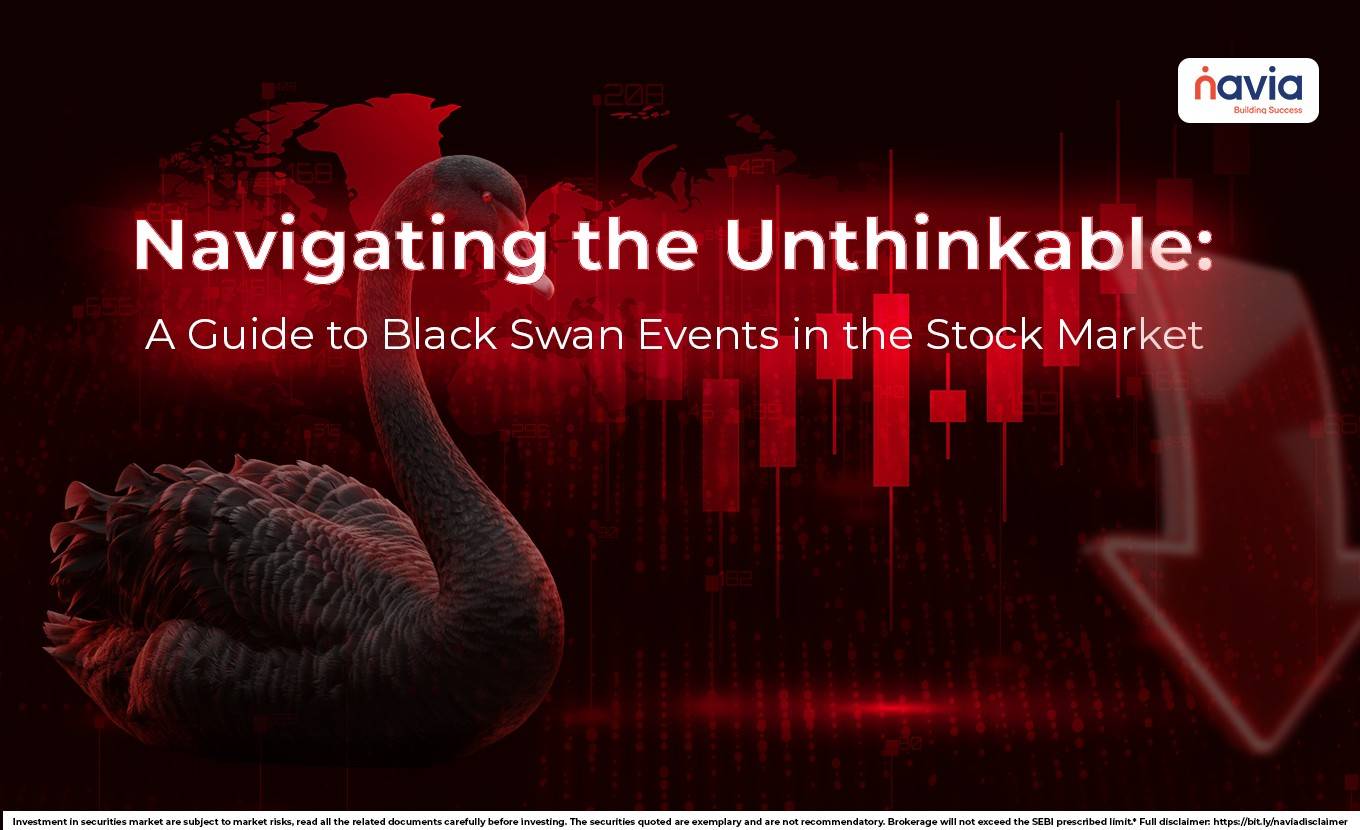
To understand the black swan events meaning, we must look at a simple view from nature. For centuries, people assumed all swans were white because they had never seen anything else. After that the discovery of a single black swan shattered this universal belief.
In financial terms, black swan events are rare, unpredictable that lie outside the realm of regular expectations. The events are characterized by three distinct traits, that are;
| Extreme Rarity | They have a very low probability of occurring based on past data. |
| Massive Impact | When they do happen, they trigger extreme price volatility and systemic shifts. |
| Retrospective Predictability | After the event, people often try to explain it as if it could have been expected, though it was truly a surprise now. |
While we usually associate these events with negative outcomes, that is an important note that they may result in sharp gains or losses depending on positioning and risk exposure.
Black Swan Events in Stock Market: Why They Happen
Now you might ask, what is black swan event in stock market term specifically? The answer is it is an event that causes the standard “normal distribution” of market return to fail.
Most trading models assume that markets move in a predictable range, but the reality exhibits “fat tails”, a statistical concept where extreme outcomes occur more frequently than traditional math suggests. Let’s see some of the common examples of black swan events;
| Global Financial Crises | Sudden systemic collapses that freeze credit markets |
| Geopolitical Conflicts | Unexpected wars or diplomatic shocks that disrupt trade |
| Pandemics | Global health crises that shut down entire economies |
| Flash Crashes | Technical glitches that cause indices to plummet and recover in minutes. |
| Regulatory Shocks | Sudden, extreme policy changes by governments or central banks. |

Danger to Options Traders: Tail Risk
If you are involved in black swan events in stock market trading through derivates, you are facing “tail risk”. It is the risk of a rare but devastating loss that occurs at the extreme ends of the return distribution.
Option trading, especially option writing, is highly exposed to this risk. Because option selling is often a leveraged activity with theoretically unlimited loss potential, a sharp unexpected move can materially impact accumulated gains.
You should understand the stop-loss trap, which means, imagine that nifty is at 26,000 and you sell put option for ₹20, keeping a stop-loss at ₹26. A black swan event gap down by 2.5% overnight; that option might open at ₹150. Your stop-loss is bypassed entirely, leaving you with a massive, unmanaged loss. This “gap risk” is a hallmark of black swan volatility.
How to Manage Black Swan Events?
The fact is you cannot predict a black swan, but you can prepare your portfolio to survive one. Below you can see four strategies recommended for managing tail risk (education purpose only):
| Avoid Naked Selling | Use risk-defined strategies (like Spreads or Iron Condors) to put a hard cap on your potential losses. |
| Prioritize Position Sizing | Never over-leverage. Ensure your position size is small enough that a catastrophic move won’t end your trading career. |
| Use Hedged Structures | While hedges might lower your average returns during “white swan” days, they provide the insurance needed to survive the black ones. |
| Accept Survival Over Maximization | Many experienced market participants prioritize capital preservation is more important than squeezing every rupee out of a bull run. |
Conclusion
Black swan events are a permanent feature of the financial landscape; they expose the hidden fragility of “perfect” trading systems and remind us that the market is a complex and unpredictable beast. So, understanding the black swan events meaning and the power of tail risk, you can move away from fragile strategies and toward a more resilient approach.
Remember, in the stock market it isn’t the daily waves that sink the ship; it’s the one-in-a-hundred-year storm that you didn’t see coming.
Do You Find This Interesting?
We’d Love to Hear from you-

Frequently Asked Questions
What are examples of black swan events?
Black swan events are characterized by their extreme rarity and inherent unpredictability, yet they possess the power to trigger massive, systemic shifts in the financial landscape. Historically, these shocks have manifested as devastating market collapses; such as the 1929 Wall Street Crash and the 1987 Black Monday, as well as broader global crises like the 2008 financial meltdown and the COVID-19 pandemic.
What is a blue swan event?
While both terms describe high-impact scenarios, they differ in how we perceive their probability:
🔹 White Swans: These are extreme events that we know are inevitable over a long enough timeline, such as stock market crashes, earthquakes, or pandemics. While we can’t calculate their exact timing or specific consequences, their eventual occurrence is predictable and certain.
🔹 Blue Swans: These represent rare, high-impact events that are conceptually possible but remain entirely unpredictable in nature. They sit in the middle ground between the “certainly occurring” White Swan and the “completely unforeseen” Black Swan.
Is AI a black swan event?
In the realm of AI, Black Swan events could manifest as the sudden, unpredicted arrival of Artificial General Intelligence (AGI); a system matching or exceeding human cognitive abilities. Alternatively, they might involve the large-scale weaponization of AI by malicious actors, such as criminals or terrorists, creating systemic security shocks that traditional safety models are unprepared to handle.
Can you profit from black swan events?
A “Black Swan event” is a rare, unpredictable occurrence that carries massive, far-reaching consequences. While these shocks typically blindside the general market, some long-term investors aim to use periods of extreme volatility to reassess asset allocation decisions.
DISCLAIMER: Investments in the securities market are subject to market risks, read all the related documents carefully before investing. The securities quoted are exemplary and are not recommendatory. Brokerage will not exceed the SEBI prescribed limit.