

A Great Company ≠ A Great Investment
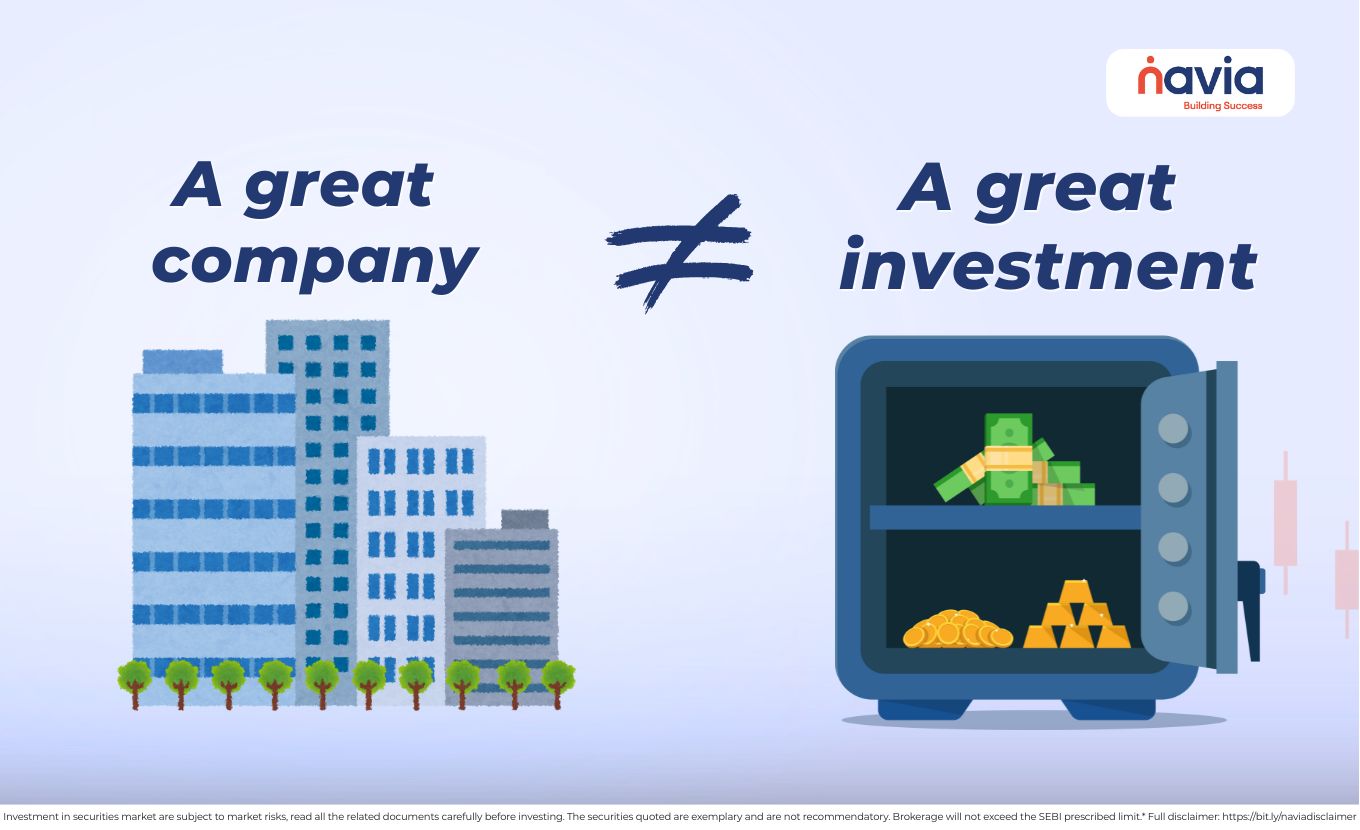
It’s a common fallacy: believing that owning shares of a company with excellent reputation, products, or brand automatically guarantees strong investment returns. In reality, what matters more is valuation at entry and future earnings growth potential. Even blue-chip firms can disappoint if purchased at a lofty price.
💡 Quick Answer
A great business and a great investment are two different things. Your return is set by two variables the company’s reputation does not control: the valuation you paid at entry and the earnings growth that follows. Buy a genuinely excellent company at an inflated multiple and you have already spent the upside — the growth simply pays you back for overpaying. Before buying, check forward Price-to-Earnings (P/E) against expected growth, look for a margin of safety, and ask whether the expected return really beats just owning the index.
Why “Good Business” Isn’t Enough?
1. Valuation Risk
You may buy a rock-solid company, but if you pay too much (high P/E, inflated multiples), your margin for error shrinks. The future upside becomes constrained. At high valuations, even modest earnings disappointments can lead to poor total returns.
Valuation is never a single number. Running the company through these 7 must-know stock market ratios gives you a fuller picture than any one multiple can.
2. Earnings Growth is the Engine
True returns are driven by how much a company can grow profits over time. A stable business with stagnant earnings will lag a faster-growing peer, even if both started with “greatness.”
Profit growth shows up first in Earnings Per Share (EPS), and DuPont analysis shows whether that growth is coming from real operating margin, from asset efficiency, or merely from added leverage.
3. The Catch-Up Burden
Investing in a firm that’s already shown exceptional performance often means you expect that performance to continue. If growth slows, your gains will be modest—or even negative—from that high base.
Real Examples: 3-Year Returns of some Blue chips vs. Nifty as on 29 September 2025. Nifty gave 42% returns over the 3 year period.
| S.No | Name | P/E | 1Yr return % | 3Yrs return % |
|---|---|---|---|---|
| 1 | Nestle India | 73.88 | -16.05 | 6.38 |
| 2 | TCS | 21.26 | -32.78 | -1.22 |
| 3 | Infosys | 21.97 | -24.38 | 0.66 |
| 4 | ITC | 25.47 | -16.88 | 9.36 |
| 5 | Pidilite Inds. | 67.82 | -12.78 | 2.93 |
| 6 | Hind. Unilever | 55.21 | -15.79 | -2.52 |
| 7 | LTIMindtree | 32.5 | -15.94 | 4.98 |
| 8 | Asian Paints | 58.37 | -29.24 | -11.17 |
| 9 | Wipro | 18.67 | -11.54 | 6.73 |
| 10 | Godrej Consumer | 63.58 | -15.2 | 8.96 |
| 11 | Titan Company | 81.32 | -10.89 | 9.27 |
| 12 | Avenue Super. | 108.9 | -11.22 | 1.08 |
| 13 | Bajaj Finserv | 33.97 | 0.7 | 6.45 |
| 14 | Ambuja Cements | 32.18 | -11.33 | 2.92 |
| 15 | Adani Energy Sol | 43.7 | -13.71 | -35.77 |
| 16 | Reliance Industries | 24.75 | -10.05 | 7.97 |
| 17 | Adani Enterp. | 80.86 | -19.83 | -10.12 |
| 18 | Adani Green | 90.52 | -47.76 | -22.92 |

What to Watch Before You Buy?
- ➣ Forward P/E / PEG Ratio – Compare valuation in relation to expected growth.
- ➣ Earnings Momentum – Current and projected earnings growth (3–5 year outlook).
- ➣ Margin of Safety – Avoid overpaying; seek valuation leeway.
- ➣ Growth Sustainability – Can competitive advantages sustain growth, or is the company entering slower phases?
- ➣ Compare with Index – Ask: “Is my expected return materially better than just owning the Nifty or a broad large-cap fund at lower cost?”
Two more checks belong on that list. Solvency: a business cannot compound if it cannot pay next year’s bills, which is what the current ratio measures. And cost structure: break-even analysis shows how much of a sales decline a company can absorb before it starts losing money.
Conclusion
A great company can earn your respect—but that doesn’t guarantee returns. Always evaluate how much you’re paying today and how much growth you’re getting tomorrow. If you enter at inflated valuations, your chance of strong returns diminishes—even for blue chips.
To round out the analysis, a SWOT analysis frames the competitive position that has to hold for the growth story to work, and the Sortino ratio tells you how much downside volatility you endured to earn whatever return you got.
Key Takeaways
- Company quality and investment quality are separate questions — the price you pay decides which one you actually get.
- A high entry multiple shrinks your margin for error, so even a small earnings miss can produce a poor total return.
- Earnings growth, not brand strength, is the engine of long-run returns; a stable business with flat profits will lag a faster-growing peer.
- Buying after a long run of exceptional performance means you are paying for that performance to continue — the catch-up burden.
- Before buying, check forward P/E against growth, insist on a margin of safety, and benchmark the expected return against a low-cost index fund.
- Related reading: 7 must-know stock market ratios, DuPont analysis, Earnings Per Share, and the current ratio.
Did you find this article helpful?
Your feedback helps us write better content.

DISCLAIMER: Investment in securities market are subject to market risks, read all the related documents carefully before investing. The securities quoted are exemplary and are not recommendatory. Full disclaimer: https://bit.ly/naviadisclaimer.