

Expiry Day Trading Costs: Why Option Trading Brokerage Charges Decide Your P&L
Quick answer
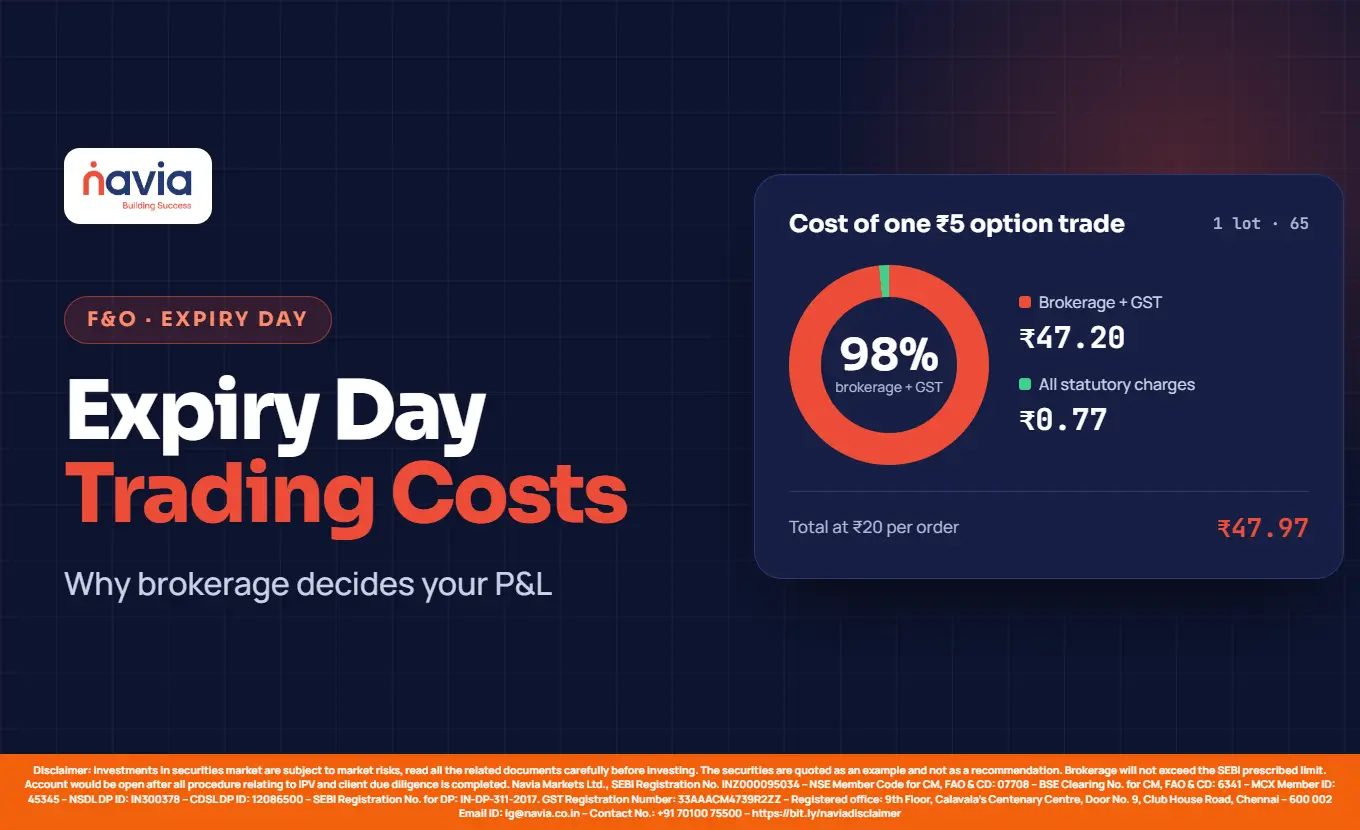
On an ordinary trading day the statutory charges on an options trade are small but visible, and brokerage already accounts for most of what a trade costs. On expiry day they all but disappear. Every statutory charge is a percentage of premium value, and premiums collapse as expiry approaches, so those charges shrink toward nothing. Brokerage is charged per order and does not shrink at all. On a Nifty option trading at ₹5 of premium, brokerage and the GST on it account for approximately 98% of the total transaction cost. The cheaper the option, the more completely brokerage determines what a trade costs.
Key takeaways
- Nifty weekly contracts expire every Tuesday on NSE; Sensex weekly contracts expire every Thursday on BSE, for contracts expiring on or after 1 September 2025.
- Statutory charges are percentages of premium value and shrink as premiums collapse near expiry; brokerage is per order and does not.
- On a Nifty option at ₹5 of premium with a lot size of 65, brokerage and GST account for approximately 98% of a ₹47.97 total cost at ₹20 per order.
- Total charges on that trade are roughly 14.8% of premium value, against roughly 1.4% on the same option at ₹60 of premium.
- Ten round trips on expiry day at ₹20 per order cost ₹472 in brokerage and GST, against under ₹10 in statutory charges.
- At ₹0 brokerage the same expiry day trade costs ₹0.77, because only the statutory charges remain.
Which day is expiry day in 2026?
The two exchanges now expire on different days, and many published articles still carry the old schedule.
On NSE, Nifty 50 weekly contracts expire every Tuesday, and monthly, quarterly and half-yearly contracts expire on the last Tuesday of the month. On BSE, Sensex weekly contracts expire every Thursday, with monthly contracts on the last Thursday.

This applies to contracts expiring on or after 1 September 2025. NSE moved Nifty weekly expiry from Thursday to Tuesday (NSE/FAOP/68747) and BSE moved Sensex weekly expiry to Thursday, after SEBI restricted equity derivatives expiry to Tuesday or Thursday and limited each exchange to one weekly benchmark index options contract on its chosen day. Check the current contract specifications on the exchange’s own site before you trade. Where an expiry day falls on a market holiday, expiry moves to the previous trading day.
Why do expiry day costs behave differently?
Because the two types of charge on an options trade scale in opposite ways.
Statutory and exchange charges are calculated as a percentage of premium value. When the premium is large, these produce meaningful amounts. When the premium is small, they produce almost nothing. Brokerage is charged per executed order. A broker charging a flat fee charges the same amount whether the option costs ₹200 or ₹2.
On expiry day, time value decays to zero and option premiums fall sharply, particularly on strikes away from the money. Traders respond by dealing in larger quantities of much cheaper options, and often by placing more orders. Both effects push brokerage up as a share of total cost at exactly the moment the percentage-based charges are collapsing.
What does an expiry day options trade actually cost?
Nifty options brokerage is charged per order, so it does not fall when the premium does. The example below uses one lot of a Nifty option trading at ₹5 of premium, bought and sold on expiry day, with a lot size of 65. Premium value per leg is therefore ₹325.
| Charge | At ₹20 per order | At ₹0 brokerage |
|---|---|---|
| Brokerage, two orders | ₹40.00 | ₹0.00 |
| STT, 0.15% of premium, sell side | ₹0.49 | ₹0.49 |
| Exchange transaction charges, both sides | ₹0.23 | ₹0.23 |
| Stamp duty, 0.003% of premium, buy side | ₹0.01 | ₹0.01 |
| SEBI turnover fee and IPFT contribution | Under ₹0.01 | Under ₹0.01 |
| GST at 18% | ₹7.24 | ₹0.04 |
| Total | ₹47.97 | ₹0.77 |
Brokerage and the GST charged on it come to ₹47.20 of that ₹47.97 total — approximately 98% of the cost of the trade. Every statutory charge combined comes to under ₹0.80.

In proportional terms, the ₹47.97 is roughly 14.8% of the ₹325 premium value. The option would need to move almost 15% in your favour before the position breaks even on costs alone.
Calculated from rates in force for FY 2026–27. STT per NSE/FATAX/73524 (31 March 2026); NSE transaction charges and IPFT per NSE/FA/73061, effective 1 March 2026. Nifty lot size of 65 per NSE Circular NSE/FAOP/70616 dated 3 October 2025, effective 28 October 2025 (EOD), revised from 75. Lot sizes are reviewed periodically by the exchanges; check the current contract specifications before applying this to a live trade.
How does this compare with a normal trading day?
Take the same option earlier in the week, trading at ₹60 of premium. Premium value per leg is ₹3,900.
At ₹20 per order, the total cost comes to approximately ₹56.44. Brokerage has not changed, but STT rises to about ₹5.85 and exchange charges to about ₹2.77.

The absolute cost has barely moved. The proportion has moved enormously. On the ₹60 option, total charges are roughly 1.4% of premium value. On the ₹5 expiry day option, they are roughly 14.8% — ten times the cost for the same number of lots, driven almost entirely by the per-order brokerage not scaling down with the premium.
What does this mean for option sellers and intraday traders?
The effect compounds with order count, which is where expiry day differs most from an ordinary session.
A trader placing ten round trips on expiry day executes twenty orders. At ₹20 per order that is ₹400 of brokerage plus ₹72 of GST, ₹472 before a single statutory charge is counted. The statutory charges on those same trades, at expiry day premiums, would total under ₹10.

For option sellers writing cheap out-of-the-money strikes on expiry day, the same arithmetic applies to premium collected rather than premium paid. A seller collecting a few rupees of premium per unit is giving up a substantial share of it to a flat fee that bears no relationship to the size of the position.
The same logic applies to intraday trading charges generally. Any strategy built on a high number of small-value transactions is a strategy where per-order costs dominate.
How does zero brokerage on F&O change the position?
It removes the charge that does not scale.
At ₹0 brokerage, the expiry day trade in the example above costs ₹0.77 rather than ₹47.97. The statutory charges are unchanged, because no broker can waive them. What changes is that the cost of the trade becomes proportional to the size of the position rather than fixed per order.
Navia charges ₹0 brokerage per order on eligible futures and options for eligible accounts, and the statutory charges apply in full. The practical effect on expiry day is larger than on any other trading day, precisely because brokerage is the charge that does not fall when premiums do. See every charge on the Navia pricing page.

How do you calculate your own expiry day costs?
Work it out before the session rather than after it.
The Navia brokerage calculator does this for a specific trade: as an options trading calculator for cost, you enter the segment, price and quantity and it returns brokerage plus every statutory charge. An options profit calculator answers a different question — the payoff and breakeven of the position itself rather than what it costs to place. Our guide to using an option calculator covers that side.
A note on expiry day risk
Conclusion
On expiry day the usual cost structure of an options trade inverts. Statutory charges, which are percentages of premium value, fall away as premiums collapse. Brokerage, which is a flat per-order fee, does not. The result is that on a ₹5 option, brokerage and its GST account for approximately 98% of the cost of the trade, and total charges consume close to 15% of the premium value. The cheaper the option and the more orders placed, the more completely the brokerage model determines what expiry day costs.
Educational content, not investment advice. Figures are illustrative; check current rates and lot sizes before you trade.
Did you find this article helpful?
Your feedback helps us write better content.

Frequently Asked Questions
Which day is Nifty expiry in 2026?
Nifty 50 weekly contracts expire every Tuesday on NSE, and monthly contracts on the last Tuesday. Sensex weekly contracts expire every Thursday on BSE. The schedule changed for contracts expiring on or after 1 September 2025.
Why does brokerage matter more on expiry day?
Because statutory charges are percentages of premium value and premiums collapse near expiry, while brokerage is a flat per-order fee that does not change. Brokerage therefore becomes a far larger share of total cost.
What are option trading brokerage charges on a cheap option?
Identical to those on an expensive one, under a flat per-order model. A broker charging ₹20 per order charges ₹20 whether the option costs ₹2 or ₹200.
Are option selling charges different from buying charges?
The charges are the same, but STT applies on the sell side and stamp duty on the buy side. For sellers of low-premium options, a flat brokerage consumes a larger share of the premium collected.
Does zero brokerage remove all expiry day costs?
No. STT, exchange transaction charges, the SEBI turnover fee, stamp duty and GST continue to apply and cannot be waived by any broker.
How do I calculate expiry day charges before trading?
Multiply expected premium by the current lot size to get premium value, apply the statutory rates to each leg, add brokerage per order and 18% GST on the fee-based charges. A brokerage calculator does this for a specific trade.