

How to Apply for an IPO Through UPI: A Complete Guide for Retail Investors
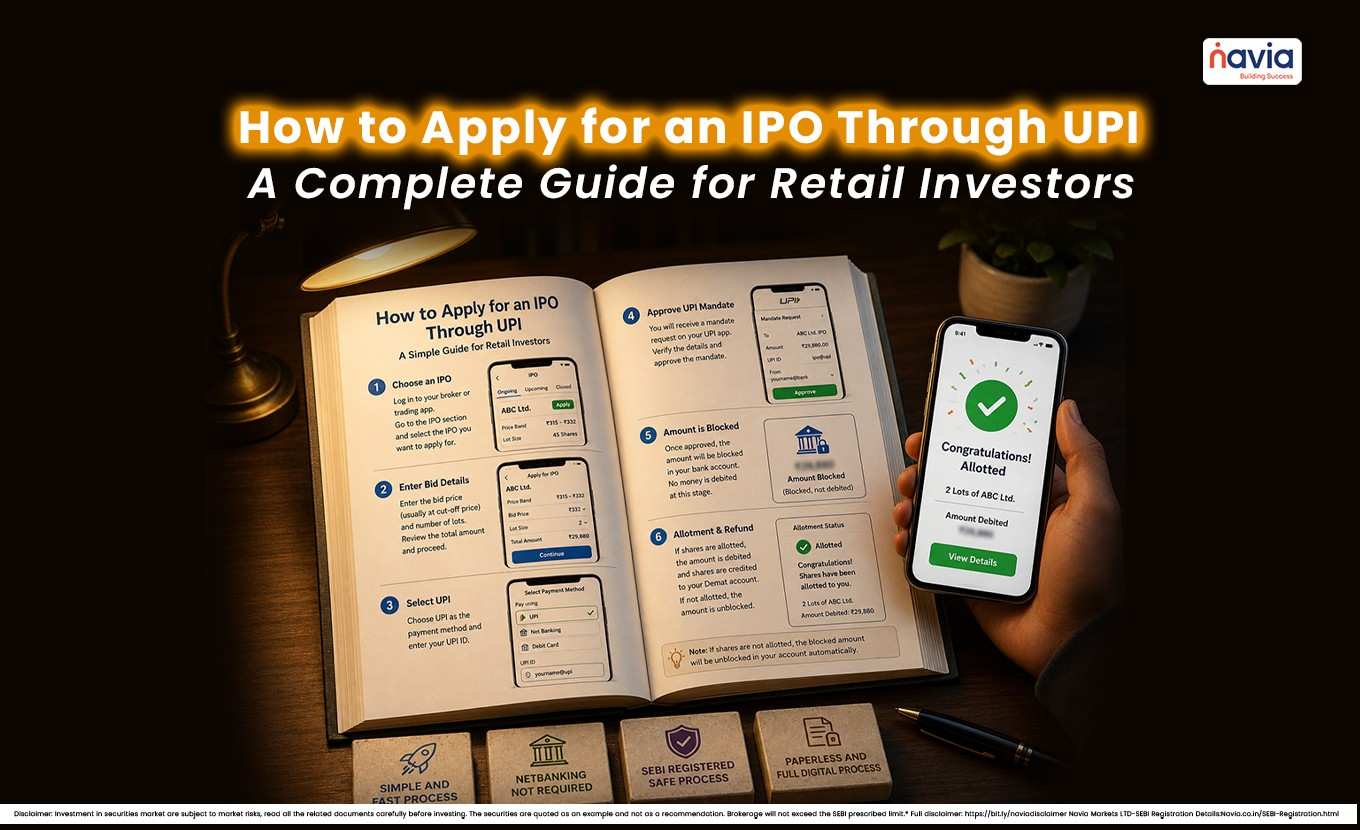
Many IPO applications are rejected due to simple, avoidable errors, such as entering incorrect details or not approving the UPI mandate on time. Today, IPO applications begin with a UPI ID—not a bank account number or cheque—because the process is routed through UPI under SEBI’s ASBA framework. Understanding how this process works can help investors apply with confidence, protect their funds, and avoid errors that may lead to rejection.
In this blog, we break down the IPO application journey, from submitting your bid to approving the UPI mandate and receiving allotment updates. You will also learn the key checks to complete before applying, so your application is processed smoothly.
UPI-Based IPO Application — Core Definitions and Mechanics
Applying for an IPO through UPI is part of the ASBA (Application Supported by Blocked Amount) system. When you submit an application, your funds are not transferred anywhere — they are blocked in your own bank account. If you receive an allotment, the blocked amount is debited. If you don’t, the block is lifted automatically.
This is different from older offline methods where investors would issue cheques or initiate bank transfers — and then wait for refunds that could take 10–15 days.
| Feature | UPI-Based (ASBA) | Offline Method (Pre-2019) | What It Means for Investors |
|---|---|---|---|
| Funds transferred upfront? | No. Funds are blocked in the investor’s bank account. | Yes. Funds were debited at the time of application. | Under ASBA, funds remain in the investor’s bank account until the allotment process is completed. |
| Interest on funds | Savings account interest may continue to accrue on the blocked amount, subject to the bank’s terms and conditions. | Since funds were debited, savings account interest did not continue on that amount. | Investors continue to retain funds in their bank account during the ASBA process. |
| If shares are not allotted | The blocked amount is released in accordance with the applicable ASBA process. | Refunds were processed after the allotment process. | ASBA removes the need for a separate refund process. |
| Risk of payment errors | Reduced due to the digital UPI mandate process. | Manual payment methods could involve a higher possibility of processing errors. | Digital processing helps minimise manual payment-related errors. |
| Maximum retail application limit | Up to ₹2,00,000 (Retail Individual Investor category, as per applicable regulations). | Up to ₹2,00,000. | The retail investment limit remains unchanged. |
| Who processes the application? | The application is processed through the broker or bank, while the UPI mandate is handled through the investor’s bank and NPCI. | Applications were submitted through the bank branch or broker using physical forms. | The IPO application process is completed digitally under the UPI-ASBA framework. |
| Paperwork | No physical forms are required. | Physical application forms and cheques were generally required. | The application process can be completed digitally. |
Key Features of UPI-Based IPO Applications:
In summary, here is what sets the UPI-ASBA route apart for retail investors:
🔹 No upfront transfer — amount only blocked in your bank account
🔹 Fully paperless and digital from start to finish
🔹 Regulated by SEBI under the ASBA framework
🔹 Available through brokers, bank apps, and investment platforms
🔹 Suitable for retail investors applying up to ₹2 lakh per IPO
🔹 Funds continue to earn savings account interest while blocked
🔹 Applicable across mainboard, SME, and rights issue subscriptions
How the UPI Mandate Process Works — Step by Step
The application process relies on two things working together: your investment platform and your UPI-enabled bank account. Understanding each step prevents the most common rejection errors.
Step 1: Open your broker, bank, or investment app
Launch any SEBI-registered platform like Navia All in One App, and navigate to the IPO section. Active IPOs will be listed with their open and close dates, price band, and lot size.
Step 2: Select the IPO and choose your lot size
Each IPO sets a minimum lot size — the smallest number of shares you can bid for. For most mainboard retail IPOs, one lot is priced between ₹10,000 and ₹15,000. You can apply for multiple lots, up to the retail ceiling of ₹2 lakh. The allotment process depends on SEBI regulations and the level of subscription. In oversubscribed retail issues, allotment is generally made through a lottery-based process.
Step 3: Enter the bid price within the price band
Every IPO comes with a price band—for example, ₹420–₹440 per share. Many retail investors choose the cut-off option, which allows them to apply at the final issue price, even if it is fixed at the upper end of the band. This helps prevent the application from being rejected for bidding below the final issue price, making it the most common option among retail applicants.
Step 4: Enter your UPI ID
Provide the UPI ID linked to your own bank account. This is critical: the UPI ID and the demat account must belong to the same individual. A mismatch leads to automatic rejection. Accepted UPI IDs include formats like name@oksbi, name@ybl, name@paytm, or any bank-linked VPA.
Step 5: Approve the mandate in your UPI app
After submission, your UPI app (BHIM, PhonePe, Google Pay, or your bank’s UPI app) will receive a pending mandate request from the registrar. Open the app, locate the mandate under “Pending Requests” or “Collect Requests,” and approve it using your UPI PIN. This must be done before the IPO issue closes. An unapproved mandate makes your application invalid — even if it was correctly filled out.
Step 6: Track your application and wait for allotment
Once the UPI mandate is approved, the application amount is blocked in your bank account. You can track your application status through your broker app, the IPO registrar’s website, or the BSE website. The registrar may be KFin Technologies, MUFG Intime India (formerly Link Intime India), or another registrar appointed for the issue.

Historical IPO Examples — How the UPI Process Has Played Out
| IPO | Year | Lot Size | Price Band | Retail Oversubscription | UPI-ASBA Process |
|---|---|---|---|---|---|
| Zomato | 2021 | 195 shares | ₹72–₹76 | ~7.4x | Retail applications were processed through the UPI-ASBA mechanism. Due to oversubscription, allotment was carried out as per the applicable allotment process. |
| LIC IPO | 2022 | 15 shares | ₹902–₹949 (₹60 discount for eligible policyholders) | ~1.99x | Retail applications, including eligible reserved-category applications, were processed through the UPI-ASBA mechanism. |
| Hyundai Motor India | 2024 | 7 shares | ₹1,865–₹1,960 | ~2.0x | Investors were required to complete the UPI mandate approval within the prescribed timeline for their applications to be considered valid. |
| Swiggy | 2024 | 38 shares | ₹371–₹390 | ~3.59x | Applications were processed through the UPI-ASBA mechanism. For applicants who were not allotted shares, blocked funds were released in accordance with the applicable ASBA process. |
| NTPC Green Energy | 2024 | 138 shares | ₹102–₹108 | ~2.55x | Retail applications were processed through the UPI-ASBA mechanism. Eligible individuals could submit separate applications using their own PAN, demat account, and UPI ID. |
What to Check if Your Application Was Rejected?
| Rejection Reason | How to Identify | What to Do Next Time |
|---|---|---|
| UPI ID mismatch | Platform may display a name mismatch or validation error. | Use a UPI ID linked to a bank account held in the applicant’s name and ensure it complies with the IPO application requirements. |
| Bid price outside the price band | Platform displays an invalid bid error. | Retail investors may consider selecting the cut-off price option, subject to the IPO terms and conditions. |
| UPI mandate not approved | Application status remains “Mandate Pending” or equivalent after submission. | Approve the UPI mandate before the IPO application closes. |
| Multiple applications from the same PAN | Duplicate application rejected by the registrar. | Submit only one valid application per PAN for a particular IPO. |
| Insufficient bank balance | UPI mandate approval fails. | Ensure sufficient available balance in the linked bank account before approving the mandate. |
How to Read an IPO Listing Before You Apply?
Every IPO comes with a Draft Red Herring Prospectus (DRHP) filed with SEBI. Most retail investors skip it. That is a mistake. The DRHP tells you everything about the issue — including details that directly affect how you should fill your application.
| What to Check? | Where to Find It? | Why It Matters? |
|---|---|---|
| Issue open and close dates | Cover page of the RHP/DRHP or broker platform | The UPI mandate must be approved before the IPO application closes. |
| Price band and lot size | Cover page and issue details | Helps determine the amount that may be blocked under the ASBA process. |
| Retail category allocation | Issue structure section | Shows the allocation applicable to the retail investor category as specified in the offer document. |
| Registrar details | Contact section | The registrar’s website can be used to check the allotment status. |
| Expected listing date | Issue timeline | Indicates when the shares are expected to be listed, subject to completion of the issue process. |
| Company financial information | Financial statements section | Provides information that investors may review before making an investment decision. |
| Grey Market Premium (GMP) | External sources | GMP is unofficial, unregulated, and should not be relied upon as the sole basis for an investment decision or expected listing performance. |
What This Means for Retail Applicants?
🔵 Selectivity is rising — Retail investors are filing fewer applications overall, but the applications being filed are increasingly for companies that investors perceive more favorably based on publicly available information. Hype-driven listings are attracting proportionally less retail interest.
🔵 Oversubscription odds have eased — With retail oversubscription dropping from 103% to 57%, your chances of allotment in well-chosen IPOs have improved compared to the FY25 peak.
🔵 SME IPOs carry higher risk — SME IPOs have lower regulatory disclosure requirements and can be more volatile post-listing. The UPI application process is the same, but due diligence requirements are higher.
🔵 GMP (Grey Market Premium) is less predictive — As investor behavior matures, the correlation between GMP and actual listing price has weakened. Apply based on business fundamentals, not GMP alone.
Grey Market Premium (GMP) is unofficial, unregulated and should not be used as the sole basis for an investment decision.
Mistakes to Avoid
❌ Using someone else’s UPI ID
Your UPI ID must belong to the same individual whose name appears first on the demat account. Even a spouse’s or parent’s UPI ID linked to a joint account will get your application rejected.
❌ Not approving the mandate before the issue closes
Submitting the application is not enough. The mandate must be approved in your UPI app. If the IPO closes before you approve, your application is invalid — and no appeal is possible.
❌ Applying with a bid price below the cut-off
If you enter a price lower than the final issue price (discovered through book building), your application is automatically rejected. Retail investors should apply at the cut-off price to avoid this.
❌ Submitting multiple applications from the same PAN
Whether across different platforms or different family members sharing a PAN (which is illegal anyway), multiple applications from one PAN for the same IPO result in all applications being cancelled.
❌ Insufficient balance in your bank account
When the UPI mandate is triggered, your bank checks for available balance. If funds are short — even by ₹1 — the mandate fails. Ensure the full blocked amount is available and not tied up in other pending transactions.
❌ Ignoring the allotment result
Some investors assume they received allotment if they don’t see the block released. Always check the allotment status on the registrar’s website or your broker platform on the allotment date. Shares are credited to your demat, not announced via SMS in all cases.
❌ Applying based only on Grey Market Premium
GMP reflects unofficial demand and is not regulated by SEBI. It can shift dramatically between application date and listing date. Many IPOs with high GMP have listed at a discount; others with low GMP have delivered strong listings.
Conclusion
The UPI-based IPO application process has made it easier for retail investors to participate in public issues by offering a fully digital experience under the ASBA framework, where the application amount remains blocked in the investor’s bank account until the allotment process is completed. However, even small mistakes—such as entering an incorrect UPI ID, failing to approve the UPI mandate within the specified timeline, or placing an invalid bid—can lead to the rejection of the application. To improve the chances of a successful IPO application, investors should verify the lot size and price band, ensure the UPI ID is linked to their own bank and demat accounts, maintain sufficient funds to cover the application amount, and approve the UPI mandate before the issue closes.
DID YOU FIND THIS INTERESTING?
We’d love to hear from you

Frequently Asked Questions
What is the minimum amount needed to apply for an IPO through UPI?
It depends on the IPO’s lot size and issue price. Most mainboard retail IPOs price one lot between ₹10,000 and ₹15,000. SME IPOs can require ₹1 lakh or more per lot. Always check the lot size and price band on the broker app before applying.
Is the IPO amount immediately deducted from my bank account?
No. The amount is blocked — not debited — when the mandate is approved. It is debited only if shares are allotted to you. If no allotment is received, the block is released automatically within 6 working days of the issue closing.
Can I apply for multiple IPOs using the same UPI ID?
Yes. You can have active mandates for several IPOs simultaneously, as long as your bank account has sufficient balance to cover all blocked amounts at the same time.
What happens if I do not approve the UPI mandate in time?
Your application is treated as invalid and will not be considered for allotment. The IPO will close without processing your bid. There is no way to retroactively approve a mandate after the issue closes.
Can I revise or cancel my bid after submitting it?
In most cases yes, you can revise your bid upward or cancel before the IPO closes, depending on the platform and the IPO’s rules. You cannot revise below the original bid price in most cases. Cancellation releases the mandate block immediately.
Is applying through UPI safe?
Yes. The process is regulated by SEBI under the ASBA framework. Your funds remain in your own bank account throughout. No third party holds your money at any point during the process.
Can NRIs apply for IPOs through UPI?
NRI investors on a repatriation basis typically use the NRI-ASBA route through their NRE/NRO bank accounts. UPI-based application availability for NRIs depends on the bank and whether their account supports UPI. Many NRIs use the physical ASBA form submitted through their designated branches instead.
Why have retail applications per IPO dropped in FY26?
Average retail applications fell from 21.31 lakh in FY25 to 12.87 lakh in FY26 as investors have become more selective. IPOs with clear business models and reasonable valuations continue to attract strong participation, while those with aggressive pricing or weak fundamentals are seeing lower retail interest — a sign of a maturing retail investor base.
DISCLAIMER: Investment in securities market are subject to market risks, read all the related documents carefully before investing. The securities quoted are exemplary and are not recommendatory. Full disclaimer: https://bit.ly/naviadisclaimer.