

What Is Open Interest Analysis & Why It’s a Game-Changer for Options Traders

- What is Open Interest (OI)?
- OI vs Volume
- Use Cases of OI Analysis for Options Traders
- 1. Spot Support and Resistance Levels
- 2. Trend Confirmation with Price
- 3. Identify Market Sentiment
- 4. Expiry Day Trades (Weekly/Monthly)
- 5. Avoid Traps and False Breakouts
- Bonus: What Is Max Pain?
- How to Access OI Data?
- Final Thoughts
- Key Takeaways
If you trade options — whether you’re a beginner or advanced — you’ve probably heard the term Open Interest (OI). But what is it really? And how can you use it to make better trading decisions?
Let’s break it down and explore the real-world use cases of OI analysis for option traders.
💡 Quick Answer
Open Interest is the total number of options or futures contracts still outstanding at a given strike and expiry. Unlike volume, which resets every day, OI is cumulative and shows how many contracts are currently live. Traders use it to spot support and resistance (high Put OI marks support, high Call OI marks resistance), to confirm a trend by pairing price with OI — up and up is long buildup, down and up is short buildup — and to read sentiment through Call and Put writing. It works as a confirmation tool, not in isolation, since it never reveals who holds the contracts.
What is Open Interest (OI)?
Open Interest is the total number of outstanding (not yet closed or exercised) options or futures contracts in the market at a specific strike price and expiry.
- If you buy 1 lot of Nifty 22,000 Call, and someone sells it to you — OI increases by 1.
- If one of you closes the trade later, OI drops by 1.
Unlike volume (which resets daily), OI is cumulative and shows how many contracts are currently “live.”
Read: 5 Simple Tools to Master Option Analysis
OI ≠ Volume
| Metric | Definition | Resets Daily? | Use Case |
| Volume | Number of contracts traded that day | Yes | Intraday action |
| OI | Total live contracts in the market | No | Position build-up or unwinding trends |
Use Cases of OI Analysis for Options Traders
1. Spot Support & Resistance Levels
High OI at a Call strike = Resistance
High OI at a Put strike = Support
Why it Matters:
These are the levels where the most contracts are open — meaning traders expect the price to stay within that range.
Example:
- Nifty 25,500 CE has the highest Call OI → Likely resistance
- Nifty 24,800 PE has highest Put OI → Likely support
2. Trend Confirmation with Price
Use the combo of Price + OI movement to decode market behavior:
| Price | OI | Interpretation |
| Up | Up | Long Buildup |
| Up | Down | Short Covering |
| Down | Up | Short Buildup |
| Down | Down | Long Unwinding |
Helps confirm if a move is genuine or driven by position closing.
3. Identify Market Sentiment
OI tells you whether traders are getting in or out, and whether they’re bullish or bearish.
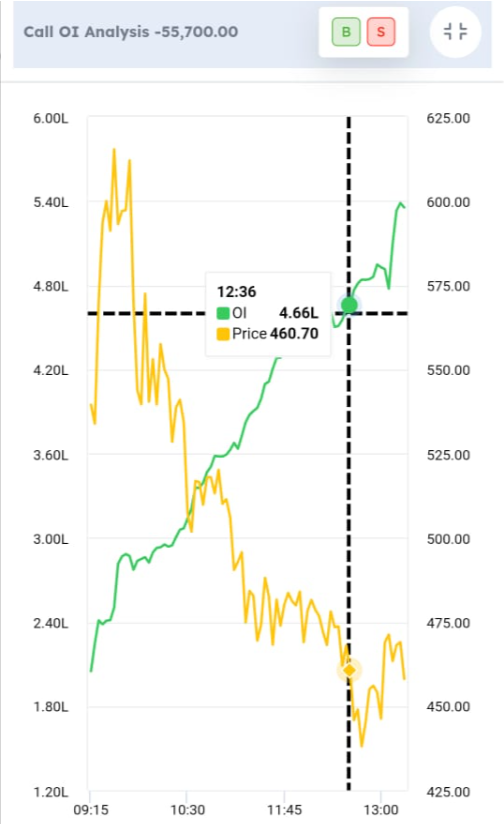
- Rising Call OI + falling Call price = Call Writing → Bearish bias
- Rising Put OI + falling Put price = Put Writing → Bullish bias
This gives insight into what smart money is doing. Pairing it with the combined ATM option premium shows whether that positioning is being made into rising or falling volatility expectations.
Below is an actual Intra-day Call OI Analysis Chart from Navia All in one Zero Brokerage APP on 19 June 2025 for Bank Nifty which shows Option Price falling with OI rising which Call Writing – > Bearish Bias
4. Expiry Day Trades (Weekly/Monthly)
On expiry day, analyzing OI shifts minute-by-minute can help you:
- Spot likely Max Pain zones
- Gauge whether resistance/support is holding or breaking
- Time your entries and exits better
Expiry-day trading also means more orders, so check which charges still apply to every F&O trade before you build a strategy around it.

5. Avoid Traps & False Breakouts
OI analysis helps you stay out of:
- Bull traps (when price spikes but OI shows no new longs)
- Bear traps (when price drops but shorts aren’t building)
Combining OI with price action = confirmation tool
Bonus: What Is “Max Pain”?
Max Pain is the strike price at which option sellers lose the least and buyers lose the most.
Traders use it to estimate where the index/stock may gravitate toward on expiry.
You can track live Max Pain levels using OI data on your broker or data provider platform.
How to Access OI Data?
Most trading platforms provide live OI data, and the NSE publishes the option chain itself, but Navia goes one step further with advanced OI + price analysis tools. How much of that OI any one participant can hold is capped by SEBI’s F&O position limits.
Final Thoughts
OI Analysis isn’t magic — but when combined with:
- Price action
- Volume
- News/Events
…it becomes a powerful tool for options traders.
Use OI to understand the battlefield — where the big players are building, defending, or exiting positions. It can provide additional insights to support decision-making.
Remember: OI is one piece of the puzzle. It doesn’t show who holds the contracts (retail vs institutional) and can sometimes give misleading signals if used in isolation.
Want to access OI Analysis Charts right away?
Download Navia APP now.
Key Takeaways
- Open Interest counts the contracts still outstanding at a given strike and expiry, and unlike volume it is cumulative rather than reset each day.
- The highest Call OI strike tends to act as resistance and the highest Put OI strike as support, because that is where most contracts are open.
- Price and OI read together give four states: long buildup, short covering, short buildup and long unwinding — which is how you tell a genuine move from position closing.
- Rising Call OI with a falling Call price signals Call writing and a bearish bias; rising Put OI with a falling Put price signals Put writing and a bullish bias.
- OI never shows who holds the contracts, so treat it as a confirmation tool alongside price action, volume and news rather than a standalone signal.
Did you find this article helpful?
Your feedback helps us write better content.

DISCLAIMER: Investments in securities market are subject to market risks, read all the related documents carefully before investing. The securities quoted are exemplary and are not recommendatory. Full disclaimer: https://bit.ly/naviadisclaimer